AI in Healthcare
Intelligent Healthcare Systems Explained for Leaders
What are intelligent healthcare systems? Explore architecture, EHR integration, AI use cases, ROI, risks and how to build compliant systems.
September 21, 2026Read more
Master AI-driven healthcare with this guide. Explore clinical use cases, regulatory requirements, vendor selection, and a practical roadmap for safe deployment.

The global AI-in-healthcare market is projected at $50.7 billion in 2026, but the hardest part of AI-driven healthcare isn't finding tools. It's governing them before they turn into compliance, safety, and workflow liabilities.
That distinction matters because healthcare leaders are no longer debating whether AI belongs in care delivery. They're dealing with a messier reality: approved devices are piling up, staff are already using unsanctioned tools, and most organizations still haven't built the operating model to control what happens next. In practice, the biggest implementation risk isn't model quality alone. It's the gap between adoption speed and organizational oversight.
Public agencies have started to reflect that shift. WHO moved from broad principles in 2021 to region-wide assessments of AI integration in health systems in 2025 and an EU-wide snapshot in 2026, treating AI in health as a governance problem, not a side experiment (WHO Europe assessment). That is the clearest sign that AI-driven healthcare has crossed from innovation theater into infrastructure planning.
Organizations that scale safely tend to do three things early. They classify products correctly, they validate AI inside realistic workflows, and they put governance in place before shadow deployment hardens into unofficial production.
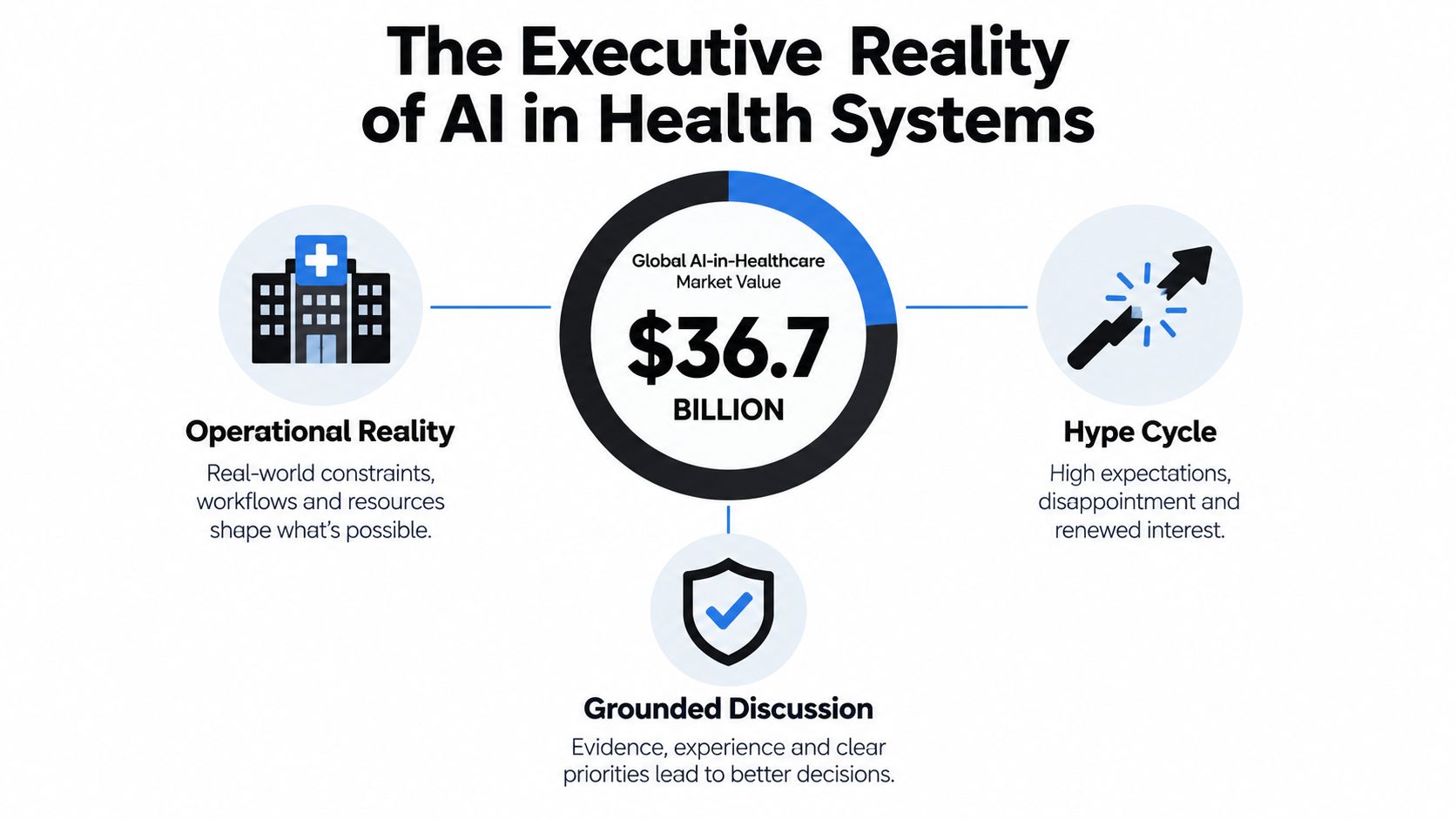
The market signal is strong. By the end of 2025, the U.S. FDA had authorized 1,451 AI-enabled medical devices, with 1,104, or 76%, in radiology alone, while independent 2026 industry summaries placed the global AI-in-healthcare market at roughly $36.7 billion in 2025 with projections around $50.7 billion in 2026 (AI in healthcare statistics). That combination tells executives two things at once: AI is commercially real, and commercialization is clustering first where validation and workflow fit are clearer.
A good pilot proves a narrow use case can function under supervision. It doesn't prove the system can absorb alerting logic, user training, clinical escalation, auditability, and procurement constraints without friction.
That's why many health systems get stuck in pilot hell. The demo works. The clinicians are interested. The board wants movement. Then integration work begins and everybody discovers the project was never the model. It was identity access, documentation standards, workflow ownership, security review, and downstream accountability.
Practical rule: If an AI tool changes a clinical decision, a patient communication, or the timing of work inside a care pathway, treat it like operational infrastructure from day one.
Leaders usually underestimate the non-model work:
For many teams, the smarter entry point isn't flashy clinical autonomy. It's tightly scoped workflow support, documentation assistance, or a privacy-first patient feedback tool that improves signal collection without creating clinical decision risk.
A capable Healthcare AI Services team usually earns trust faster by making existing workflows safer and cleaner before introducing higher-risk automation.
A large share of AI projects in care delivery create regulatory exposure long before anyone files a formal submission. The mistake is rarely the model itself. It is the gap between how staff use the tool in practice and how the organization documented its intended use.
If a product influences diagnosis, treatment, triage, or risk scoring tied to care decisions, classification work starts early. A chatbot interface does not change that.
The FDA states that AI/ML-based software intended to treat, diagnose, cure, mitigate, or prevent disease is a medical device under the FD&C Act and is treated as Software as a Medical Device, so the key question is intended medical purpose, not whether the product uses AI (FDA discussion paper on AI and machine learning).
Teams get into trouble when product language says "assistant" while rollout plans, prompts, and user behavior say "clinical guidance." Regulators will care about the function, the claims, the workflow context, and the foreseeable use inside care delivery. Internal governance should care even sooner, because shadow deployment often outruns formal review.
A simple operating test helps:
| Product behavior | Likely implication |
|---|---|
| Summarizes internal notes or extracts admin information | Lower device risk, but privacy, security, and documentation controls still apply |
| Produces treatment suggestions or diagnostic recommendations | Higher likelihood of medical device scrutiny |
| Scores risk or prioritizes patients in a way that changes care actions | Early regulatory and clinical safety review is warranted |
The FDA's AI/ML-based SaMD Action Plan points to five priorities: a Predetermined Change Control Plan for software that evolves over time, support for good machine learning practices, user transparency, improved algorithm evaluation methods, and real-world performance monitoring pilots (FDA AI/ML Action Plan).
That matters operationally. A model that changes without documented controls creates two problems at once. The regulatory file gets weaker, and the health system loses the ability to explain why output quality shifted after release.
I have seen teams spend months debating model performance while no one could answer a simpler question: who approves prompt changes, threshold changes, or new data sources after go-live? In regulated settings, that is not paperwork overhead. It is product control.
Cross-border health systems and vendors face another trap. One country may treat a workflow support tool as lower risk, while another may view the same function as clinical decision support with tighter obligations. The classification question is only part of the job. You also need a defensible operating model for validation, change management, incident review, and audit evidence across jurisdictions.
That is why governance has to sit next to product and clinical leadership, not behind them. If staff can adopt tools through departmental budgets or browser tabs before central review, your regulatory posture becomes fictional.
Use a decision path before engineering and procurement harden the wrong assumptions:
Teams that need SaMD implementation support and regulatory delivery services usually do not fail because the algorithm is novel. They fail because classification, quality ownership, and approval paths were treated as cleanup work after the pilot already spread.
The next trap is assuming a fluent model is a deployment-ready clinical agent. It isn't. Healthcare AI breaks at the point where text has to become action.
Stanford's MedAgentBench built a virtual EHR with 100 realistic patient profiles and 785,000 records, then tested about a dozen large language models on 300 physician-designed clinical tasks such as retrieving data, ordering tests, and prescribing medications via FHIR API endpoints, while HealthBench was built with 262 physicians practicing in 60 countries and contains 5,000 realistic health conversations scored by physician-created rubrics (MedAgentBench and HealthBench details).
Those benchmarks matter because they move evaluation away from trivia-style medical recall. In deployment, the hard parts are state tracking, missing context, multi-step tool use, and knowing when to escalate.
A model can sound excellent and still be unsafe inside production systems. Common failure modes look mundane:
HealthBench points in the same direction from a different angle. If the benchmark uses clinician-authored rubrics across realistic conversations, then evaluation has to include communication quality, context handling, and instruction following, not just answer accuracy.
The benchmark you choose decides what kind of failure you will miss.
Before a team puts an agent into clinical operations, it should test three layers:
This is also where AI Product Development Workflow discipline matters more than prompt tinkering. The maturity shift in AI-driven healthcare is moving from "Can the model respond?" to "Can the system complete the task safely inside a real environment?"
As we explored in our AI adoption guide, the shortest path to production is rarely the fastest path in week one. It's the path that exposes failure conditions before clinicians do.
The biggest threat to scalable AI-driven healthcare isn't a lack of tools. It's that staff are already using them outside formal controls.
Recent surveys report that 72% of healthcare organizations have AI tools or agents deployed without formal IT approval, fewer than 40% of payer/provider organizations have detailed policies for employee use of generative AI, and 60% of payers say employees are using unauthorized shadow AI tools (Imprivata research on shadow AI in healthcare).

Clinicians and operators aren't trying to undermine governance. They're trying to remove friction. If referral intake is slow, documentation is repetitive, or internal handoffs are messy, staff will test whatever saves time.
That creates a dangerous pattern. The first unofficial use cases often look harmless: summarizing notes, drafting messages, cleaning spreadsheets, or reviewing denial language. Then those outputs start influencing care operations, billing decisions, patient communication, or security exposure without audit trails or approval boundaries.
Blanket bans rarely hold. Generic AI policies don't hold either. Staff ignore both if the sanctioned path is slower than the unsanctioned one.
What works better is operational containment:
A practical reference point is this guide to deploying compliant AI, which aligns well with the controls health systems usually need once experimentation has already escaped the lab.
The old question was whether to adopt AI. That question is gone.
The question is who owns the controls when adoption starts bottom-up. Governance boards help, but only if they can approve patterns quickly enough to keep up with workflow demand. In my experience, the most effective teams treat governance as a service to the organization, not as a brake pedal. They publish approved tooling, define disallowed data flows, and create pathways for safe experimentation.
If your staff can deploy AI faster than your organization can review it, you don't have an innovation problem. You have a control problem.
Most KPI discussions in healthcare AI go off track because they focus on activity, not consequence. Usage volume, prompt counts, and pilot enthusiasm don't tell an executive whether the system is safer, faster, or more equitable.
I prefer to sort outcomes into three operating lenses:
| Lens | What to check | What failure looks like |
|---|---|---|
| Patient safety | Escalation reliability, auditability, clinician override, harmful output review | Staff trust the tool more than the controls around it |
| Workflow velocity | Time saved in review loops, handoff clarity, reduction of duplicate work | New steps get added faster than old steps disappear |
| Financial sustainability | Integration effort, support burden, compliance overhead, maintenance ownership | Savings on paper, hidden costs in operations |
That structure forces honesty. A tool can help speed and still fail safety. Another can pass validation and still be too expensive to maintain in a fragmented environment.
A 2026 U.S. access study found that 79.5% of people lived within a 30-minute drive of surgical robotics, but only 65.8% lived within 30 minutes of AI-enabled hospitals, leaving 114.6 million people outside that threshold (U.S. access study summary).
That gap should change how executives define success. If AI-driven healthcare only lands in already well-resourced institutions, then "efficiency" can become another form of concentration.
Use a mixed scorecard:
As we explored in our AI adoption guide, the right question isn't whether AI improves a workflow somewhere. It's whether it improves the workflow where capacity is thinnest and oversight is hardest.
Health systems do not fail at AI because they lack ideas. They fail because they move a pilot into production before they have settled ownership, controls, and escalation.
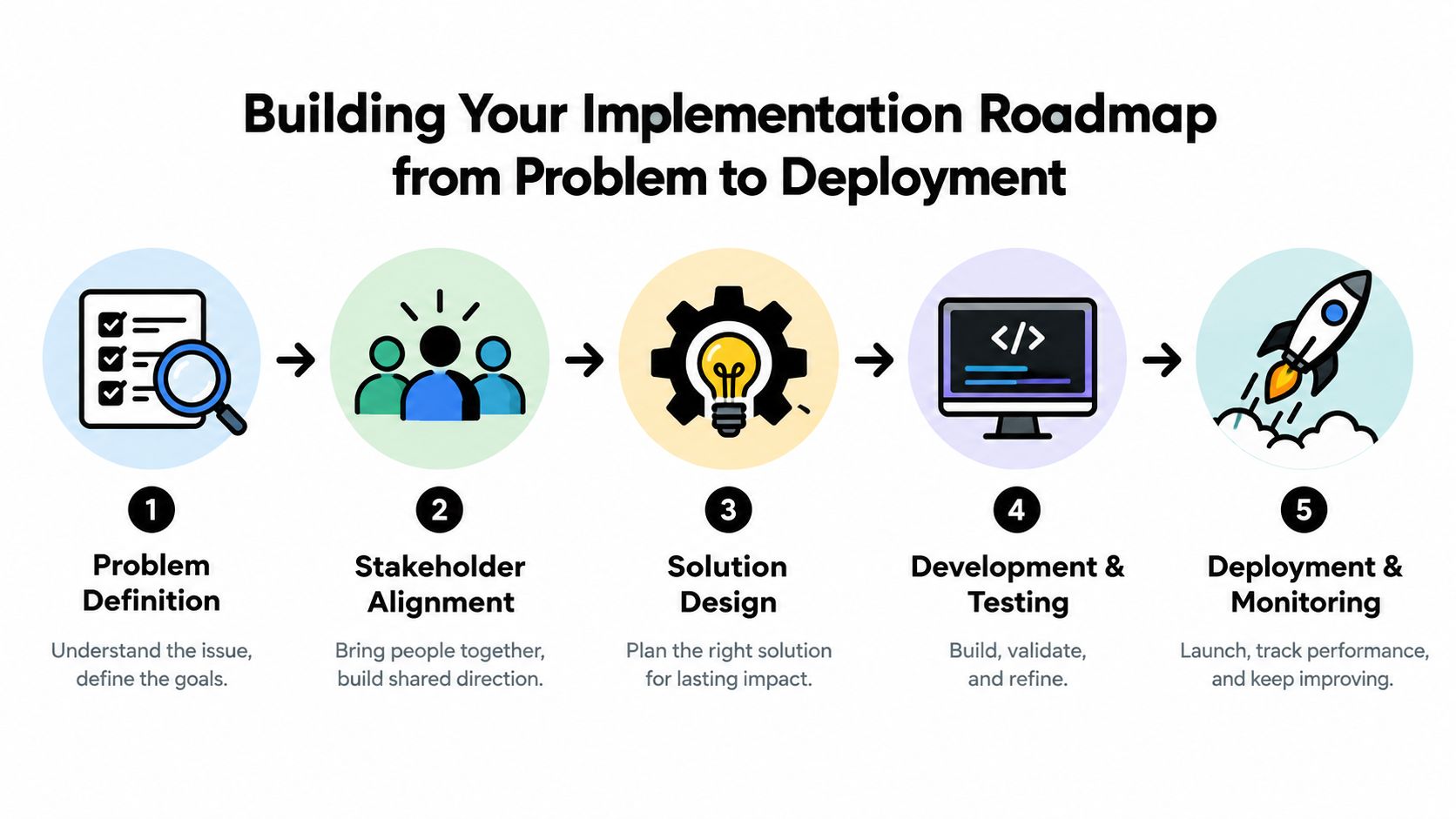
The roadmap that survives contact with clinical operations usually starts with one narrow workflow and one accountable owner. "Reduce admin burden" is not a roadmap input. "Cut duplicate note entry for ED physicians after discharge decisions" is specific enough to scope data access, review points, and success criteria.
A practical sequence looks like this:
Define the operational failure
Describe the broken step, who feels it, what delay or rework it creates, and what a good result looks like in daily use.
Assign decision rights early
Clinical leadership, operations, IT, security, compliance, and legal need named roles before any build starts. If those groups only appear at sign-off, the project stalls or ships with avoidable risk.
Design controls with the workflow
Set data boundaries, tool permissions, human review rules, fallback behavior, and audit logs at the same time you design the user experience. Retrofitting control logic later is expensive and usually incomplete.
Test under production conditions
Use messy records, interruptions, ambiguous inputs, and edge cases. A model that looks accurate in a calm sandbox often breaks when clinicians are busy and context is thin.
Deploy in a narrow lane first
Start with constrained permissions, a limited user group, and visible monitoring. Expand only after override patterns, failure modes, and handoff points are understood.
The hard part is not model selection. The hard part is preventing informal use from outrunning formal oversight.
That governance gap shows up early. A department finds a tool, staff prove it saves time, and usage spreads before anyone has approved data handling, documentation standards, or incident response. By the time central IT or compliance gets involved, the workflow is already socially embedded. Shutting it down creates backlash. Allowing it to continue creates unmanaged risk. That is why governance belongs inside the implementation roadmap, not at the end of it.
I have seen this repeatedly in health systems that were serious about AI and still got trapped in pilot hell. Teams funded a proof of concept, validated a narrow use case, and then discovered they had no agreed process for change control, model updates, or clinical accountability. The technical work was often the easy part.
A stronger approach uses a delivery method that ties product decisions to controls from day one. A structured AI delivery framework for healthcare implementation is more useful than another loosely governed sprint because it forces teams to answer the uncomfortable questions early: who owns the workflow, what must be reviewed by a human, what gets logged, and who has authority to pause deployment if behavior drifts.
Start with the workflow. Build the controls into it. Expand only after the operating model holds under real clinical pressure.
The build-versus-buy decision in healthcare AI sets your risk profile long before launch. It determines who owns failures, who can change the system, and how quickly governance can keep up with deployment.
Custom development makes sense when the workflow itself is the product, the integration requirements are unusual, or the organization needs tight control over data movement, user permissions, and interface behavior. I usually see that in EHR-linked orchestration, care operations platforms, and internal tools that encode site-specific clinical or administrative logic.
That control has a price.
A custom program only works if the organization can support product management, clinical review, security, integration engineering, testing, monitoring, and maintenance as an ongoing function. If one of those capabilities is weak, the result is often a system that performs well in a demo and becomes hard to operate safely in production.
For some teams, the practical answer is a mixed delivery model. They use a healthtech engineering partner, custom healthcare software development capacity, and a dedicated regulatory compliance partner instead of trying to hire every specialty at once.
Specialized AI services are often the better choice when the workflow is common across organizations, speed matters more than differentiation, and the main execution risk is adoption rather than novel product design. That is especially true for administrative automation, documentation support, and standardized operational workflows.
The trade-off is straightforward.
| Path | Strength | Trade-off |
|---|---|---|
| In-house build | Maximum control and product ownership | Slower setup, broader hiring burden, higher long-term oversight burden |
| Specialized partner | Faster execution and reuse of proven delivery patterns | Less control over architecture and implementation details |
| Hybrid model | Internal ownership with external delivery support | Requires clear decision rights, strong vendor management, and disciplined scope control |
External strategy support can help before any build starts. The value is not the slide deck. The value is forcing early decisions about intended use, system boundaries, review points, and who has authority to stop deployment if the operating model breaks.
Procurement teams often compare features first. In healthcare AI, I would start with operating discipline.
I would ask six direct questions:
If a vendor cannot answer those questions clearly, the problem is not immaturity in the sales process. The problem is that the operating model probably does not exist yet.
Organizations also need to be honest about what they are buying. Some are buying a point solution. Some are buying delivery capacity. Some are buying a longer-term capability that central IT, compliance, and operational leaders will need to manage together. Ekipa AI is one option in that market for teams that need healthcare-focused engineering support across strategy, integration, and delivery. Real-world use cases can help teams compare that kind of support against narrower vendors before they commit.
The best choice is the one your organization can govern after the contract is signed, not the one that looks most impressive during evaluation. In health systems, that difference decides whether AI becomes a maintained capability or another stalled pilot.
At this point, it's both, but governance is the constraint that gets underestimated most often. Many organizations can access capable tools. Far fewer can control intended use, data access, auditability, and human oversight at scale.
It becomes a Software as a Medical Device question when the software is intended to treat, diagnose, cure, mitigate, or prevent disease. The trigger is intended medical purpose, not the fact that the software uses AI.
Because clinical work happens in context. Systems need to handle multi-step workflows, structured records, tool permissions, ambiguity, escalation, and communication quality. Strong performance on isolated text tasks doesn't prove readiness inside care operations.
Shadow AI. Teams often start using unsanctioned tools to solve immediate workflow pain, which creates security, privacy, and accountability gaps before formal governance catches up.
Use a scorecard that includes patient safety, workflow velocity, financial sustainability, and access equity. If the tool saves time but weakens oversight or widens capability gaps across sites, the rollout isn't successful.
That depends on how differentiated the workflow is and whether you can support compliance, integration, and maintenance over time. In-house build offers control. Partners offer speed and established delivery patterns. A hybrid model often works best when decision rights are clear.
If you'd like to pressure-test your roadmap, our expert team is a good place to start.
Ekipa AI helps health teams turn AI ideas into governed, deployable systems, from early strategy and workflow scoping to EHR integration, validation, and delivery. If you're trying to close the gap between fast adoption and safe oversight, visit Ekipa AI and evaluate the implementation path before shadow AI makes the decision for you.
What are intelligent healthcare systems? Explore architecture, EHR integration, AI use cases, ROI, risks and how to build compliant systems.

Learn what AI healthcare software is, where it delivers ROI, and how leaders evaluate vendors, integrations, regulation, and rollout in 2026.
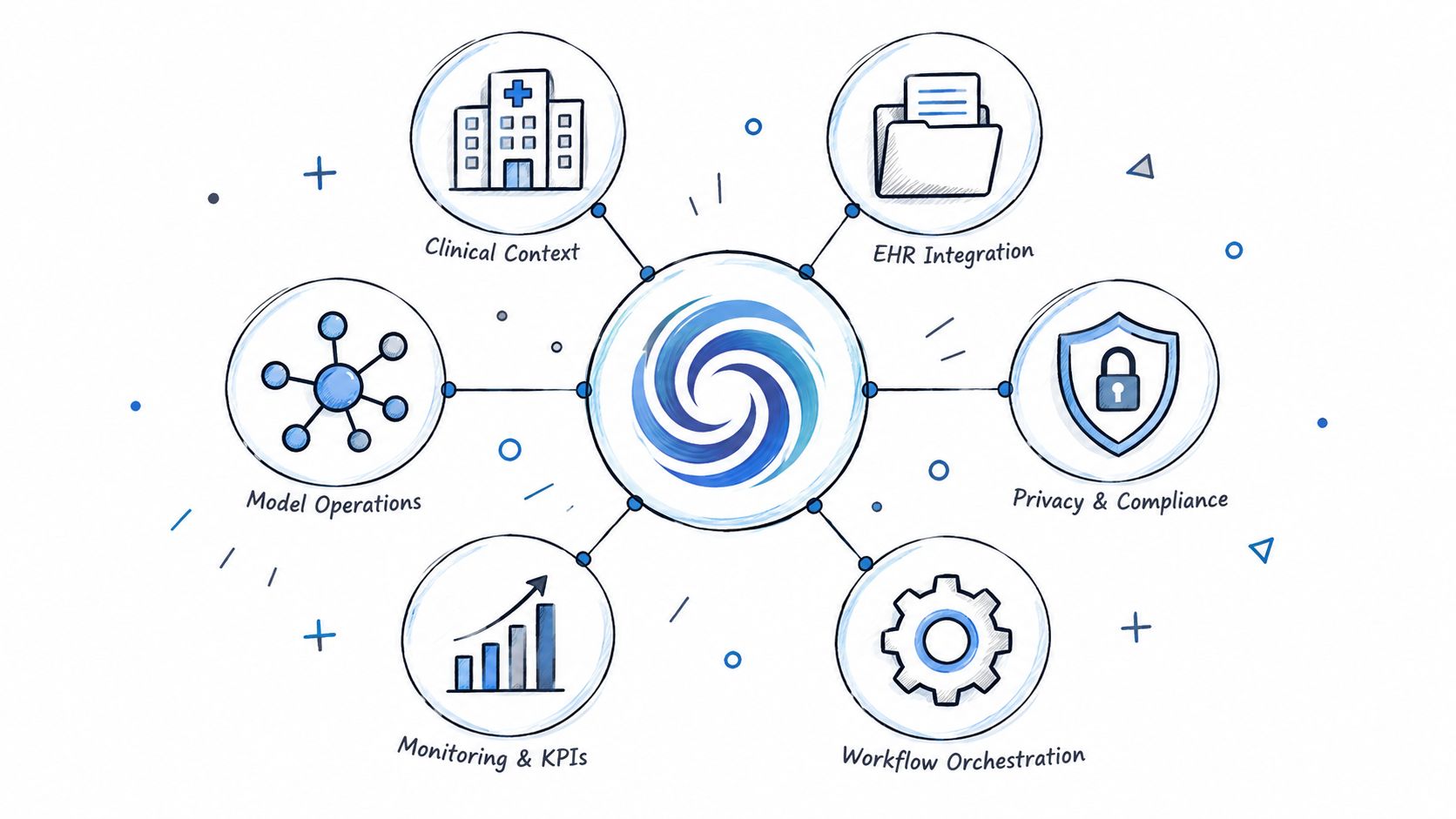
Learn how an AI healthcare platform works, what to look for, and how to scale it inside real clinical systems without breaking compliance or workflows.
Connect with our team to explore how AI expertise can transform your business.