
AI in Healthcare
Smart Healthcare Technology: The Complete 2026 Guide
Discover how smart healthcare technology transforms patient care, reduces costs, and improves outcomes. Learn about IoT, AI, EHR integrations
September 22, 2026Read more
Learn what AI healthcare software is, where it delivers ROI, and how leaders evaluate vendors, integrations, regulation, and rollout in 2026.

Most advice about AI healthcare software is backwards. Leaders keep asking which model to buy, whether FDA clearance solves risk, or whether budget is the blocker. In real deployments, those questions come second.
The first question is simpler and harder. Can your organization govern this thing after go-live, and can it fit into the workflow clinicians already use without slowing them down?
That's why buyers who want results should think about governance and integration before model quality. The market has already shifted. Predictive AI embedded in EHR workflows moved from 66% of U.S. hospitals in 2023 to 71% in 2024, with adoption in 2024 rising from 53% in small hospitals to 80% in medium hospitals and 96% in large hospitals according to the ONC hospital trends brief. That's not a pilot story. It's an infrastructure story.
If you're building, buying, or modernizing AI healthcare software, treat this as an engineering and operating model decision. The right setup usually involves an EHR-native product surface, hard audit trails, role ownership across clinical and technical teams, and a plan for post-deployment monitoring. That's the work a good healthtech engineering partner helps structure before a single workflow gets automated.
The popular explanation is that healthcare AI stalls because regulation is too slow or budgets are too tight. I don't buy that. If that were true, adoption inside mainstream provider workflows wouldn't be expanding the way it is.
The blocker is that teams buy software before they've settled three operational questions: who owns the output, where the output lands, and how the organization monitors it after launch. Those failures don't show up in demos. They show up in month four, when clinicians stop using the tool, IT doesn't trust the logs, and legal realizes nobody defined acceptable use.
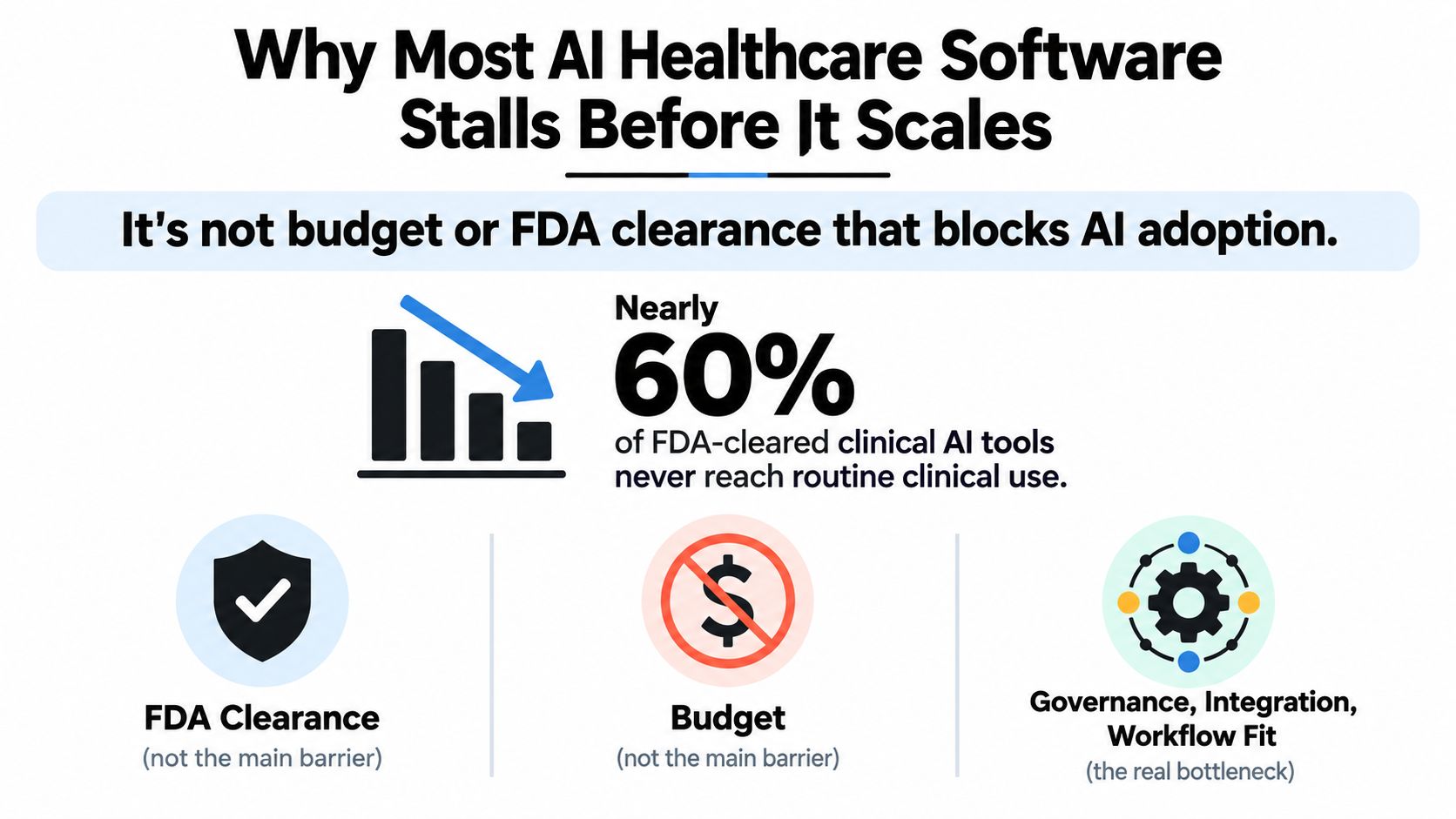
Independent reporting points to the governance problem directly. 72% of healthcare organizations have AI tools or agents deployed without formal IT approval, and nearly half of organizations allowing generative AI have no formal approval process, while even fewer monitor usage, according to the 2026 healthcare AI industry report. That's the shadow-AI issue most glossy explainers skip.
When a clinician pastes PHI into a consumer assistant, that isn't innovation. It's unmanaged risk. When a vendor updates a model inside an existing product, that isn't progress either unless your team can trace what changed and who signed off on continued use.
Practical rule: If you can't name the owner of model monitoring, audit review, and workflow escalation, you don't have an AI deployment. You have an unmanaged experiment.
The first cracks tend to show up in ordinary places:
That's why serious teams start with AI requirements analysis and operating constraints, not model shopping. If you're doing this well, your AI strategy consulting work should look more like service design and controls engineering than prompt experimentation.
Executives get this wrong all the time. They buy a model and call it a product. In healthcare, the product is the control system around the model.
AI healthcare software is a governed application layer that uses machine learning or generative models inside clinical or operational work. The model matters, but deployment success usually depends on integration, policy, traceability, and who owns decisions after go-live. If those pieces are weak, accuracy gains on a benchmark will not save the rollout.
A practical definition starts with four layers:
Inference layer
The model performs a task such as prediction, summarization, extraction, classification, ranking, or generation.
Clinical control layer
This sets intended use, review thresholds, safety checks, source traceability, exception handling, and escalation paths.
Workflow delivery layer
The output must appear inside the system where work already happens, whether that is the EHR, PACS, rev cycle queue, contact center console, or patient messaging tool.
Governance layer
This covers logging, access control, versioning, override capture, approvals, monitoring, and post-deployment review.
That last layer gets ignored far too often. It is also where shadow AI spreads, because teams can access model output before security, compliance, and clinical leadership have defined the rules.
Buyers are not paying for a model in isolation. They are paying for controlled behavior inside a regulated workflow.
Lumping every healthcare AI product into one budget line is lazy and expensive. The evidence standard, integration pattern, and risk profile differ by category.
These tools influence diagnosis, triage, imaging interpretation, treatment support, or care prioritization. Examples include radiology classifiers, deterioration risk models, and symptom-triage engines. Products in this category can cross into Software as a Medical Device if they are used to diagnose, treat, mitigate, cure, or prevent disease. Use a regulatory-grade operating model from day one. Do not retrofit it later.
These products target the business of care delivery. Common examples include scheduling optimization, coding support, denial prevention, staffing forecasts, prior authorization assistance, and bed management. The mistake here is assuming lower clinical risk means lower control needs. It does not. A flawed operational model can still create billing errors, throughput bottlenecks, and ugly audit exposure.
These tools capture, draft, summarize, and communicate. Ambient scribes, visit summarizers, inbox assistants, and patient message drafting tools sit here. They look lightweight, but they often touch PHI, alter documentation quality, and shape clinician behavior at scale. Treat them as workflow infrastructure, not convenience software.
A CEO should be able to name which category each AI product falls into, who owns it, and what failure looks like. A CTO should know which layer is custom, which layer comes from the vendor, and which controls the organization must run itself.
That is why offerings such as healthcare AI services, SaMD programs, and custom healthcare software development should be scoped by governance burden and integration depth first, not by model type.
The cleanest production architecture in healthcare is usually FHIR-first, even when your source systems are not. That doesn't mean everything originates as FHIR. It means your operational interface layer should normalize toward it so downstream AI outputs can re-enter clinical workflow without brittle custom plumbing.
The U.S. interoperability guidance is clear on the foundation. AI applications commonly consume or produce data through HL7 FHIR resources such as demographics, encounters, problems, observations, medications, and procedures, supporting workflows including clinical decision support, quality measurement, and prior authorization in the AI interoperability appendix. Build around that reality.
A practical reference architecture usually has four tiers.
| Tier | Core Components | Integration Pattern |
|---|---|---|
| Ingestion | HL7v2 feeds, FHIR R4 APIs, DICOM studies, claims files, device streams | Interface engines, API pulls, event subscriptions |
| Normalization | Patient identity resolution, terminology mapping, longitudinal record assembly | Canonical data model with FHIR-aligned schemas |
| Intelligence | Feature pipelines, vector or rules retrieval, model serving, policy controls | Real-time inference APIs and batch scoring jobs |
| Delivery | SMART on FHIR apps, CDS surfaces, structured write-back, alert routing | Embedded EHR widgets, cards, tasks, and note inserts |
A single inference journey often works like this:
The chokepoints are never glamorous. Identity reconciliation breaks more projects than model tuning. De-identification gets misunderstood. Bi-directional persistence back into the chart is often harder than getting the first output onto a dashboard.
If your output can't become a task, note, order suggestion, routing cue, or structured chart element, it won't survive contact with production care delivery.
That's why teams building internal platforms should invest in internal tooling, workflow-safe orchestration, and an AI Product Development Workflow that treats interoperability as a product feature, not middleware cleanup.
Most organizations spread money across too many AI use cases. That's a mistake. The market is already signaling where deployment is real and where it's still mostly aspiration.
A 2025 industry study reported that healthcare AI spending reached $1.4 billion, nearly triple the 2024 level, and 22% of healthcare organizations had deployed domain-specific AI tools, with providers at 27%, outpatient organizations at 18%, and payers at 14% according to Menlo Ventures' state of AI in healthcare. The same study found imaging and radiology as the most widely deployed clinical AI use case, with 90% reporting at least partial deployment, while clinical documentation tools such as ambient note generation had a 100% adoption activity rate and 53% reported high success.
Those numbers point to a blunt conclusion. Fund the workflows buyers already operationalize. Be skeptical of categories where the sales deck is stronger than the integration plan.
| Use Case | Category | Maturity Stage | Primary ROI Metric |
|---|---|---|---|
| Ambient documentation | Clinical | Scaled | Clinician time reclaimed |
| Radiology triage | Clinical | Scaled | Faster report prioritization |
| Clinical decision support | Clinical | Early adopter to scaled | More consistent risk intervention |
| Prior authorization support | Clinical | Early adopter | Faster submission and fewer manual touches |
| Revenue cycle automation | Operational | Early adopter to scaled | Reduced denials and staff effort |
| Capacity orchestration | Operational | Early adopter | Better bed and throughput coordination |
| Patient communication automation | Operational | Pilot to early adopter | Lower call-center burden |
If I were advising a CEO with limited budget, I'd prioritize in this order:
Buyers don't need ten AI use cases. They need two that can be adopted, measured, and governed.
What I'd avoid first is broad “clinical copilot” software sold as a universal layer for every specialty. Those products often collapse under local workflow differences and weak attribution of value.
For teams comparing packaged products with custom build paths, one useful benchmark is this clinic AI assistant. Not because every buyer needs that exact product, but because it illustrates the shape of a focused workflow tool versus a vague all-purpose assistant.
If you want more examples of deployable categories, browse real-world use cases instead of generic AI trend lists.
The fastest way to stall an AI program is to treat regulation as a filing exercise and privacy as a contract appendix. In healthcare, both are operating constraints. They shape product scope, architecture, vendor choice, and who is allowed to use the tool on day one.
Start with intended use. If the software is informing diagnosis, treatment, mitigation, cure, or prevention, you may be in medical-device territory. If it is summarizing notes, routing work, or drafting patient messages, the rules and evidence burden look different. Leaders who blur those categories create two problems at once. They trigger regulatory confusion, and they let shadow AI spread into clinical work without clear approval boundaries.
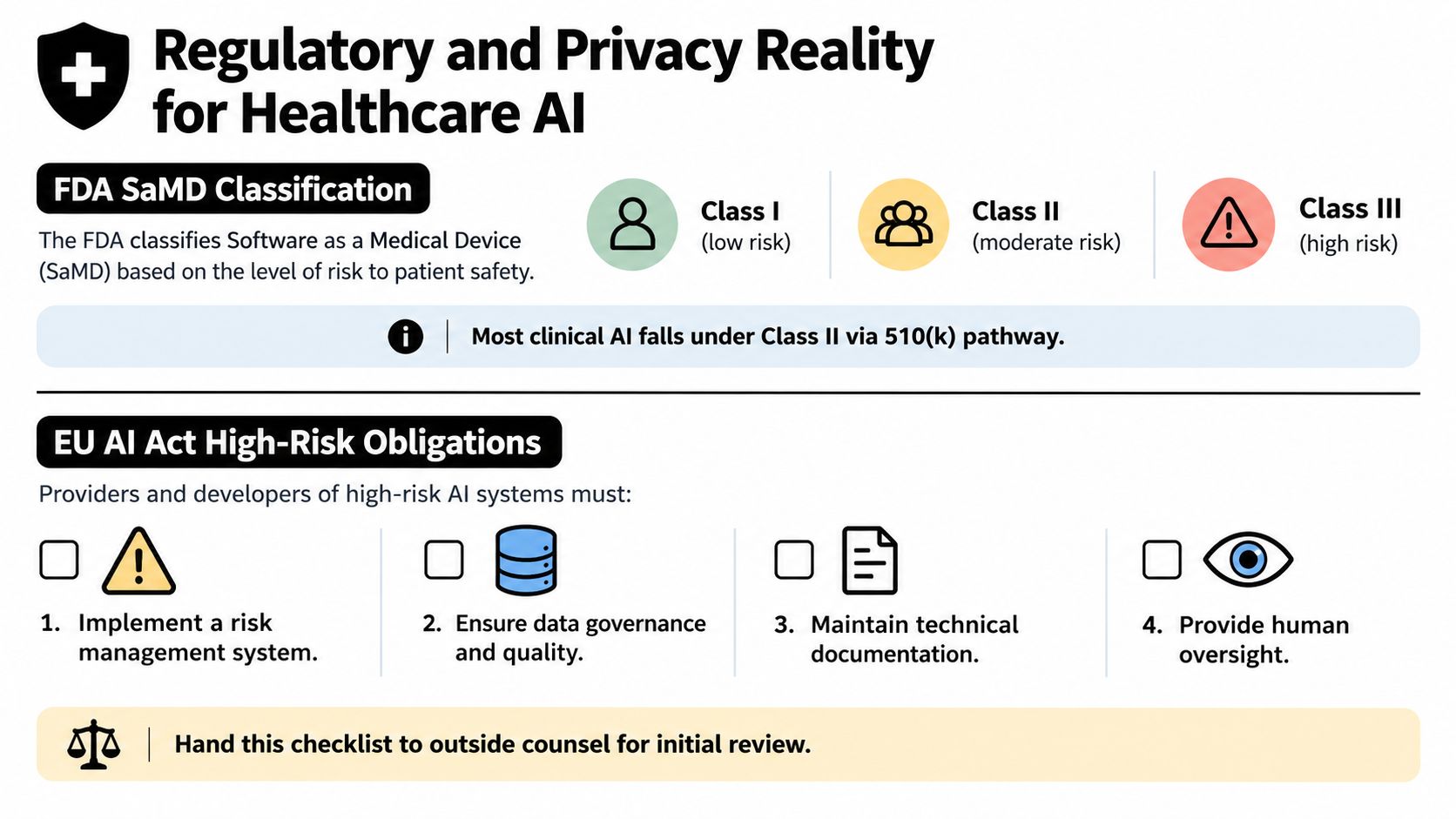
The regulatory question is not just "does this vendor have clearance?" The harder question is whether your deployment still matches the cleared or documented use once it is embedded in local workflow, connected to your data, and updated over time.
That is where governance usually breaks.
A practical review should cover five areas:
Most explainers stop at pre-launch compliance. That misses the failure point. Risk increases after deployment, when a model changes, users find side-door workflows, or a nonclinical assistant starts influencing clinical decisions through habit rather than policy.
Privacy review belongs in architecture, not cleanup. If your team cannot answer where prompts are processed, what identifiers are exposed, how long outputs are retained, and whether logs contain PHI, you are not ready to scale.
The same goes for shadow AI. Staff will use general-purpose tools if the approved workflow is slow or unclear. Banning that behavior in policy is not enough. You need sanctioned tools, identity controls, logging, and clear write-back boundaries. If your security and legal teams need a control baseline, this guide to enterprise AI compliance tools is a useful companion.
Compliance in healthcare AI is a control system. If you cannot see usage, versioning, and data movement, you do not control the risk.
For products that cross into regulated clinical functionality, separate that workstream early and treat it like a product line with its own evidence, quality, and release discipline. A focused plan for software as a medical device implementation services belongs in that discussion. It should not be buried inside a vague enterprise AI platform initiative.
One more blunt recommendation. Put a named owner on post-deployment governance. Not a committee. One accountable leader with authority over model intake, approval, monitoring, and retirement. Without that, privacy review becomes theater, regulatory review becomes slow, and AI use spreads faster than your controls.
Most healthcare AI procurement processes still overweight clearance labels and underweight evidence quality. That's lazy buying.
Regulatory status matters. It is not enough. Independent review of the cleared AI medical-device environment found 1,357 cleared AI medical devices, but only 34, or 2.5%, were linked to registered prospective trials, only 12, or 0.9%, posted results, and only 3, or 0.2%, evaluated patient-centered outcomes such as mortality, morbidity, or readmissions in the PLOS Digital Health review. If you're buying on clearance alone, you're accepting a major evidence gap.
Vendor evaluation should include a weighted scorecard across six areas.
| Evaluation Area | What to Check |
|---|---|
| Validation rigor | External validation, prospective endpoints, care-setting match |
| Workflow fit | EHR embed, role-based UX, write-back capability |
| Reliability | Latency expectations, uptime commitments, fallback behavior |
| Governance | Audit trails, model versioning, rollback procedures |
| Safety monitoring | Drift review, subgroup performance checks, escalation path |
| Commercial terms | Data-use rights, indemnification, retirement and exit terms |
Ask these in the first serious call:
If a vendor can answer feature questions but can't explain model rollback, usage monitoring, and data rights in plain English, move on.
This is also where a buyer benefits from outside operator judgment. A useful review partner should test the vendor's claims against your workflow, not just against a procurement checklist. If you're comparing custom and packaged options, AI tools for business can help frame what belongs in-house versus what should stay vendor-provided.
Most AI programs don't fail in the pilot. They fail in the handoff from pilot to production.
The fix is a disciplined rollout with clear decision gates. The roadmap doesn't need to be exotic. It needs to force cross-functional alignment before each expansion step.
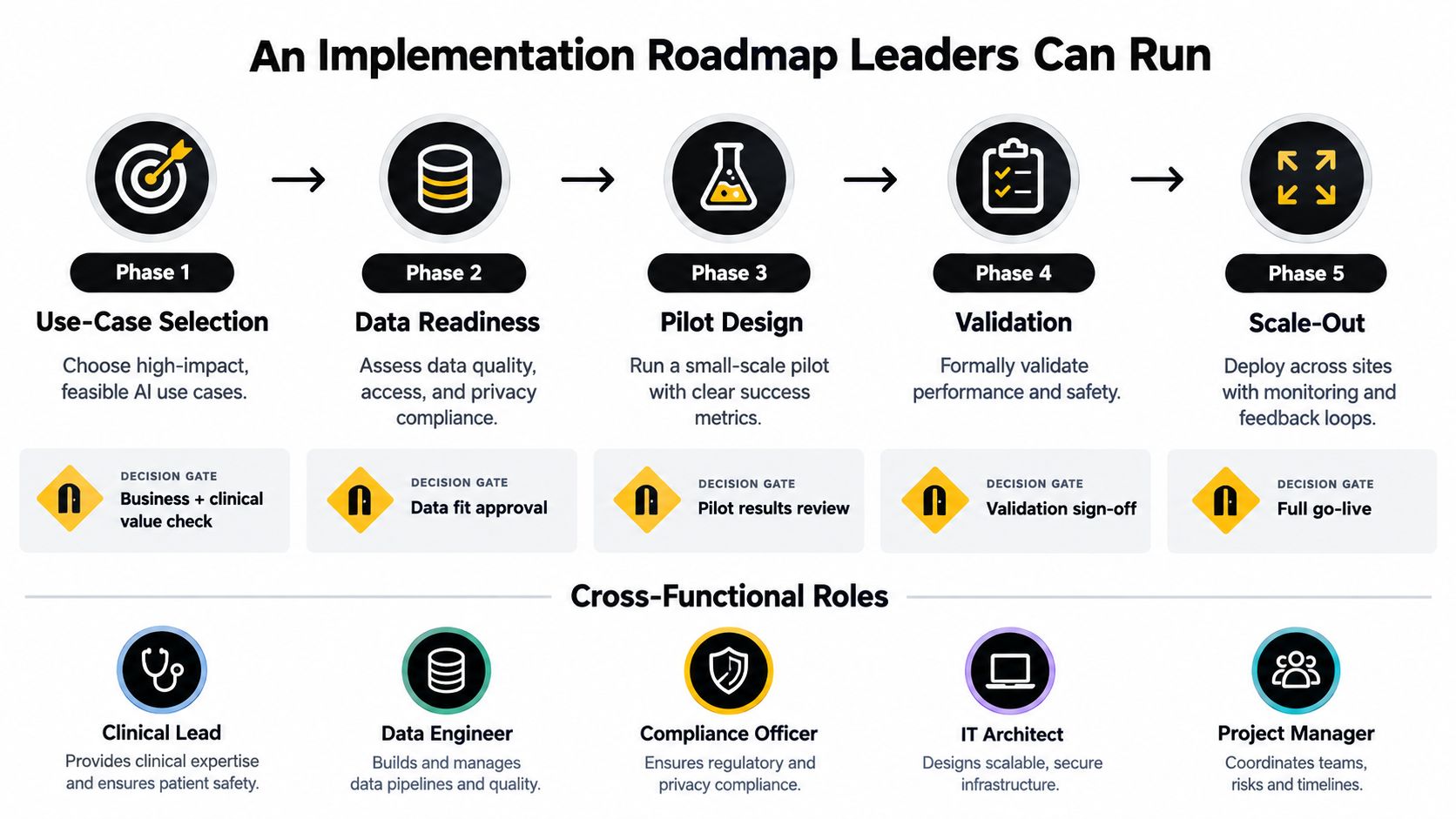
Use-case selection
Pick one workflow with real pain, available data, and clear ownership. Name the executive sponsor and clinical champion immediately.
Data readiness
Confirm access, quality, privacy constraints, interoperability, and write-back feasibility. Many “easy” ideas die for good reason.
Pilot design
Define user cohort, success criteria, fallback path, and review cadence. Keep the pilot narrow enough that behavior can be observed closely.
Validation
Assess technical performance and practical usability in the target environment. A WHO evidence framework separates verification testing against technical performance requirements from clinical validation in the care setting, as summarized in this clinical AI developer pathway analysis.
Scale-out
Expand only after governance sign-off, integration hardening, training, and post-launch monitoring are all in place.
A workable delivery team usually includes:
The gate before scale is the one that matters. If your pilot worked only because a project manager manually reconciled edge cases, you don't have a scalable system yet.
Teams that need a structured operating approach often benefit from an explicit AI Automation as a Service model or a defined AI delivery framework. The point isn't the label. The point is having a repeatable handoff from prototype to governed production.
As we explored in our AI adoption guide, roadmap discipline beats model sophistication almost every time.
The right KPI set depends on the workflow. The wrong KPI is “people liked the demo.”
For clinical use cases, I care about adoption in workflow, override rates, turnaround time, and whether outputs consistently reach the point of care. For operational use cases, I care about task completion, denial reduction, routing efficiency, and throughput stability. Across both, I want governance metrics too: exception review volume, model update logs, audit completion, and ownership of remediation.
| Metric Category | Example KPI | Representative Case Pattern | Reported Outcome |
|---|---|---|---|
| Adoption | Active use in target workflow | Ambient documentation rollout | Sustained workflow use matters more than initial enthusiasm |
| Clinical operations | Turnaround or prioritization improvement | Radiology triage support | Faster handling of urgent studies |
| Administrative efficiency | Manual work reduced | Prior authorization or coding support | Staff effort shifts away from repetitive steps |
| Capacity management | Better coordination across units | Bed and staffing forecasting | Lower churn in daily operational decisions |
| Governance | Exception review and version control | Post-deployment AI oversight | Safer scaling and clearer accountability |
First, the ambient documentation pattern. It works when output lands inside charting workflow, source traceability is visible, and clinicians can correct fast without extra clicks.
Second, the imaging triage pattern. It works when prioritization is embedded in existing review queues rather than asking radiologists to open another console.
Third, the operational forecasting pattern. It works when recommendations trigger staffing or bed-allocation action, not when they sit in a side dashboard that nobody checks during shift pressure.
The next quarter's action list for most leadership teams is straightforward:
If you want durable results, staff AI oversight like you staff EHR governance. Give it owners, review cadence, and authority. That's the difference between a tool people sample and a system the organization can trust.
If you want a deeper build-vs-buy conversation, a Custom AI Strategy report can force the right questions early, and our expert team is the right place to sanity-check whether your roadmap matches your technical and compliance reality.
Ekipa works with healthtech product teams on AI integration, EHR workflow design, compliance-aware delivery, and production rollout discipline. If you're trying to turn AI healthcare software from a promising pilot into something clinicians use, visit Ekipa AI and start with the workflow, governance, and architecture decisions that determine whether the product will scale.
No. For most providers and digital health teams, it's primarily a governance, integration, and workflow problem. A strong model still fails if nobody owns monitoring, the output sits outside the EHR, or the vendor can't support auditability.
It becomes SaMD when the software meets the definition of a medical device and its output is used to diagnose, treat, mitigate, cure, or prevent disease or a condition, as noted earlier in the regulatory section.
Because outputs only create value when they can move through real clinical workflows. FHIR gives teams a practical way to normalize data and make AI results usable inside decision support, quality, and prior-authorization workflows.
Ambient documentation, imaging workflow support, and selected operational automation categories are the most commercially mature based on the deployment patterns cited earlier.
Start with five questions: what data the vendor uses, whether outputs are traceable, how model updates are managed, how the tool integrates with your EHR workflow, and who owns post-deployment monitoring.
Start with an inventory. Identify what tools staff are already using, what data enters those tools, whether formal approval exists, and which workflows need sanctioned alternatives. Then establish ownership for ongoing review rather than treating the issue as a one-time cleanup.
Discover how smart healthcare technology transforms patient care, reduces costs, and improves outcomes. Learn about IoT, AI, EHR integrations

What are intelligent healthcare systems? Explore architecture, EHR integration, AI use cases, ROI, risks and how to build compliant systems.

Master AI-driven healthcare with this guide. Explore clinical use cases, regulatory requirements, vendor selection, and a practical roadmap for safe deployment.
Connect with our team to explore how AI expertise can transform your business.