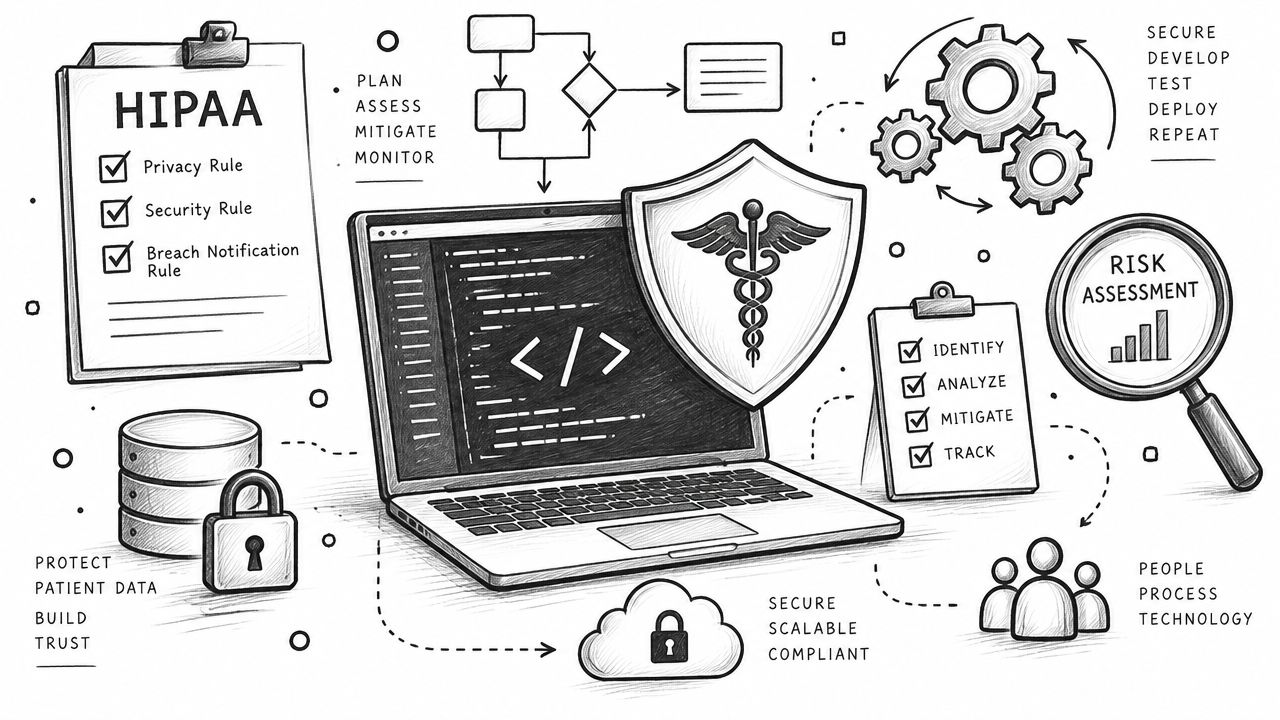
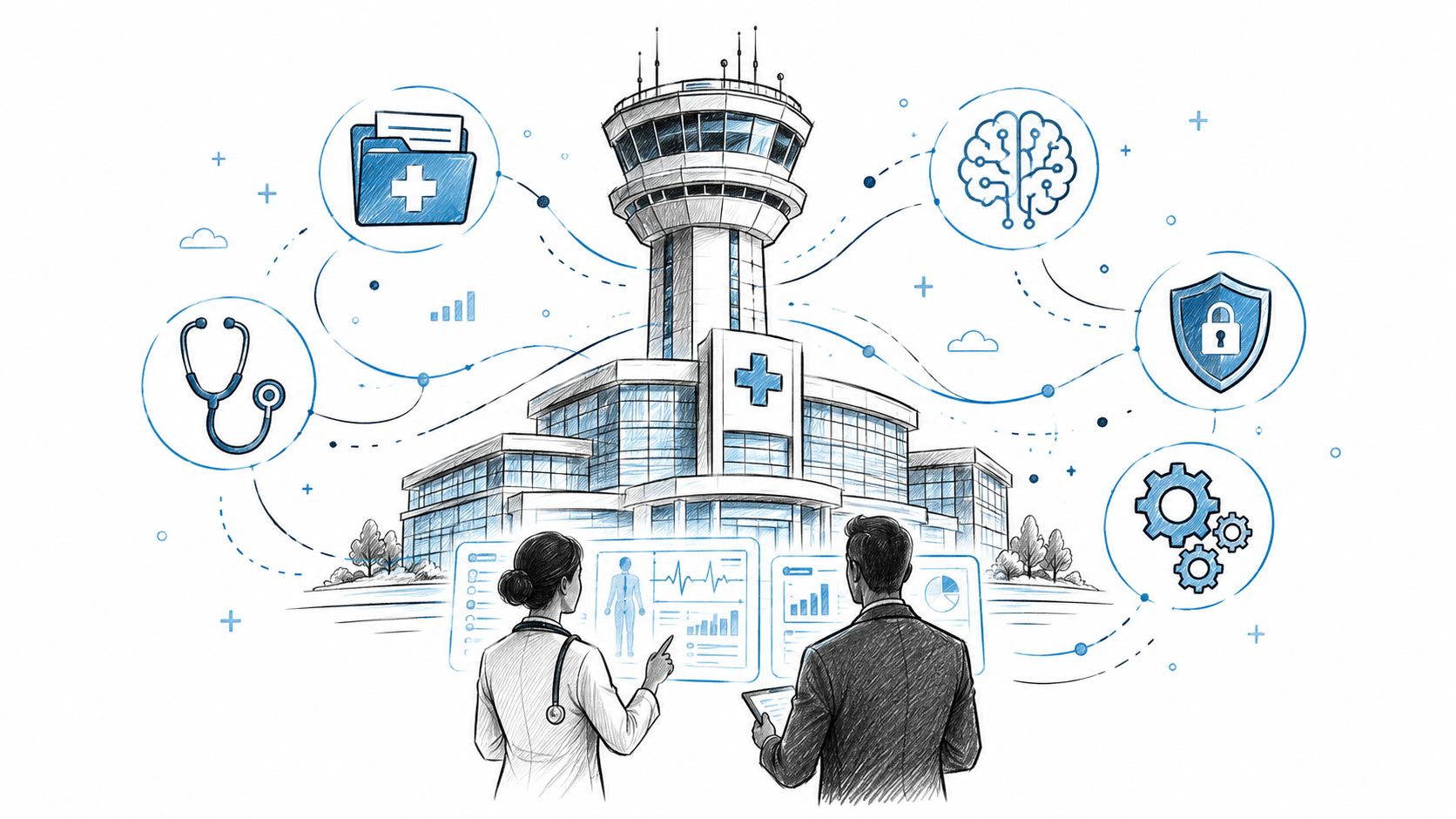
A hospital can buy an AI tool and still feel stuck. Radiology drafts move faster, but nurses still chase missing fields, revenue teams still copy data between systems, and leaders still can't prove which pilot is worth scaling. That gap is why AI transformation in healthcare is not a software purchase, it's an operating-model change.
The market is already moving in that direction. One independent 2025 industry study found 22% of healthcare organizations had deployed domain-specific AI tools, a 7x increase versus 2024 and a 10x increase versus 2023. It also estimated $1.4 billion in healthcare AI spending in 2025, with health systems accounting for about $1 billion, or 75% of total spend (Menlo Ventures 2025 healthcare AI study).
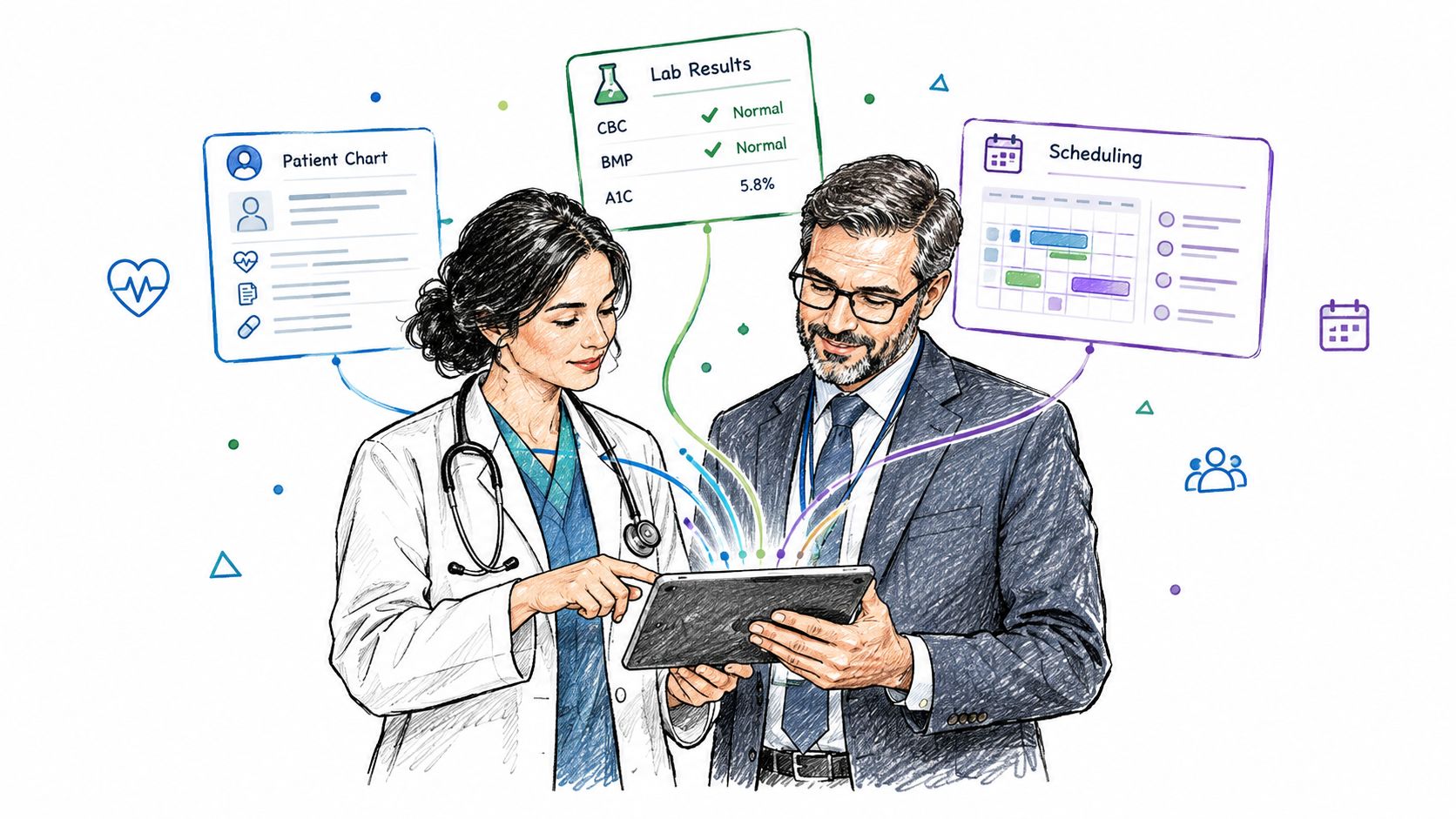
For CEOs, CTOs, operations leaders, and product owners, the key question isn't whether AI can help. It's how to move from scattered experiments to governed, EHR-connected systems that change throughput, quality, and trust. If you want a broader view of how a healthtech engineering partner approaches this kind of change, the healthcare page at Healthcare AI Services is the right place to start.
Introduction to AI Transformation in Healthcare
A hospital intake team can start the day with a full queue, a fragmented EHR, and a stream of exceptions before lunch. Add an AI assistant for note drafting, and the pilot may look strong in isolation. Two months later, staff still copy data into several systems, clinicians still question the output, and finance still cannot measure value.
That gap separates using AI from transforming with AI. Tool adoption improves one task. Transformation changes how information moves, how work is approved, and how leaders decide what gets scaled.
Why the operating model matters
AI transformation is less like adding a new machine to a ward and more like redesigning the ward itself. If the data is messy, the workflow is broken, or governance is vague, the model just automates confusion. Strong programs treat data quality, process design, and ownership as one system, not three separate projects.
Practical rule: if people still manually translate data between systems, AI will amplify the bottleneck instead of removing it.
That matters beyond the clinical side. Procurement, compliance, implementation, and support all change once AI affects documentation, triage, and reimbursement. The right starting point is the business problem, then the work that should be automated, the work that should be assisted, and the work that should remain under direct human control.
Who this matters for
This guide is for leaders who need AI to work inside real healthcare constraints. CTOs need architecture that can survive legacy EHRs. Product owners need use cases that justify the build effort. Operations leaders need a roadmap that avoids pilot purgatory.
If you want a structured way to turn strategy into implementation, a Custom AI Strategy report can help frame priorities. For teams that need help aligning scope and ownership, AI strategy consulting gives a broader starting point. The point is simple, AI transformation starts when the organization changes how it runs, not when it buys another tool.
What AI Transformation Really Means for Health Systems
AI transformation in a health system has three layers. The first is the data layer, where patient, claims, imaging, and operational data need to be usable. The second is the workflow layer, where that data enters clinician and admin processes. The third is the operating model layer, where leaders set guardrails, assign ownership, and decide how AI gets measured.
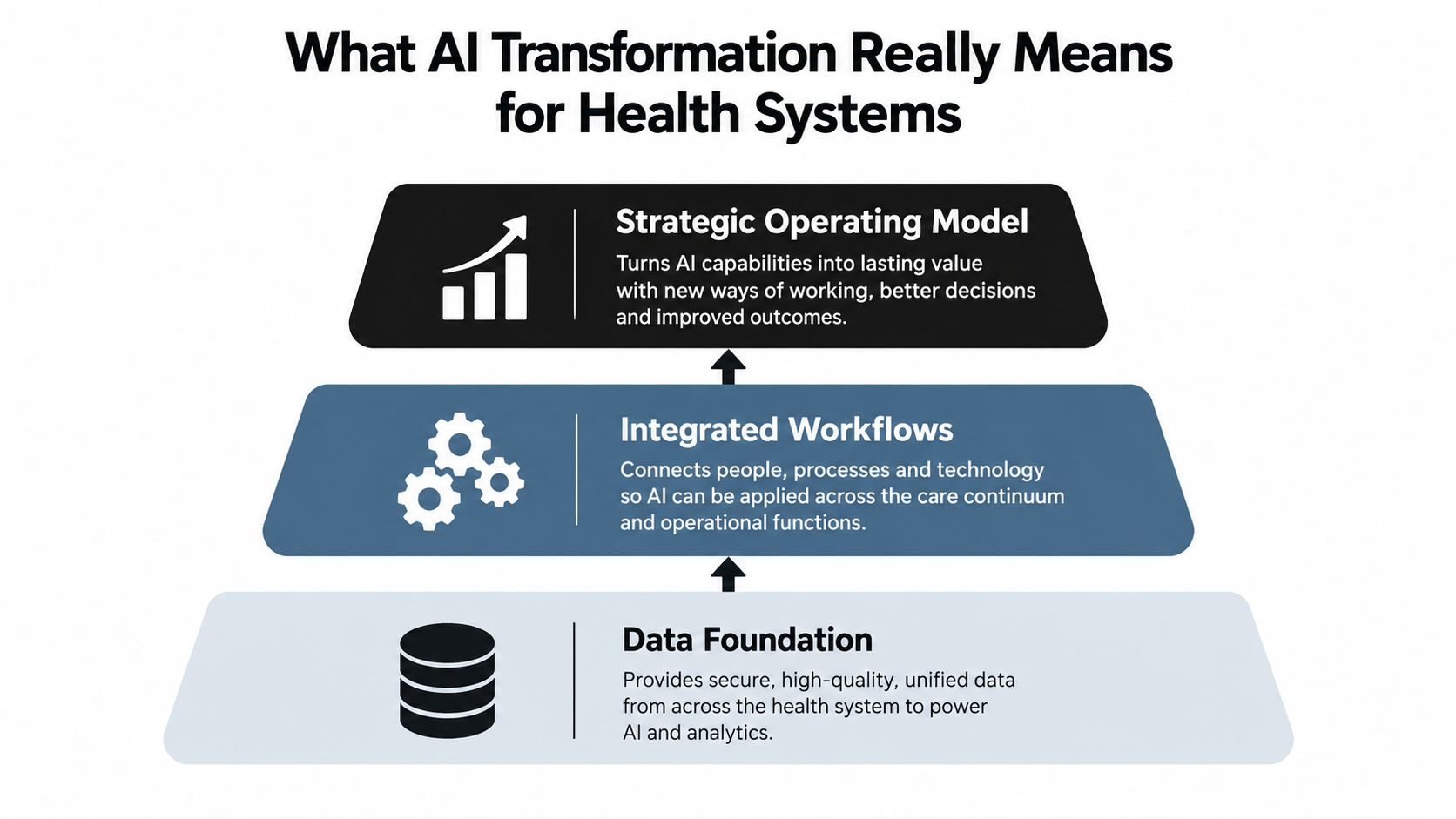
A hospital wing can have the right equipment and still underperform if the power, plumbing, and staff routines are not updated. AI works the same way. A strong model can sit on top of weak data flows and broken handoffs, and the result is just faster confusion.
Automation, augmentation, and decision support
Automation removes repetitive work, such as routing messages or extracting fields from forms. Augmentation helps a human move faster, such as drafting a clinical note or summarizing a chart. Decision support goes a step further into recommendation, but it still needs oversight, especially in clinical settings where mistakes carry real risk.
AI transformation starts when leaders stop asking, “What can this model do?” and start asking, “What work should change, who approves it, and how do we know it is safe?”
The operating model has to support that answer. Teams often need lightweight review screens, escalation paths, audit logs, and task routing before they need another model. The AI Product Development Workflow matters because it turns AI from a prototype into a repeatable delivery process.
Why pilot programs stall
Most pilots fail for familiar reasons. The use case is too broad, the workflow is unclear, or ownership is split across IT, clinical, and operations. A standalone chatbot may look convincing in a demo, but transformation happens only when it is embedded into the systems people already use, not parked beside them.
Readiness means the organization can support the change end to end. If it cannot, the first investment is usually the data model, the workflow design, and the decision rights around deployment. That is the difference between an experiment and an operating model.
High Impact Use Cases That Deliver Measurable Value
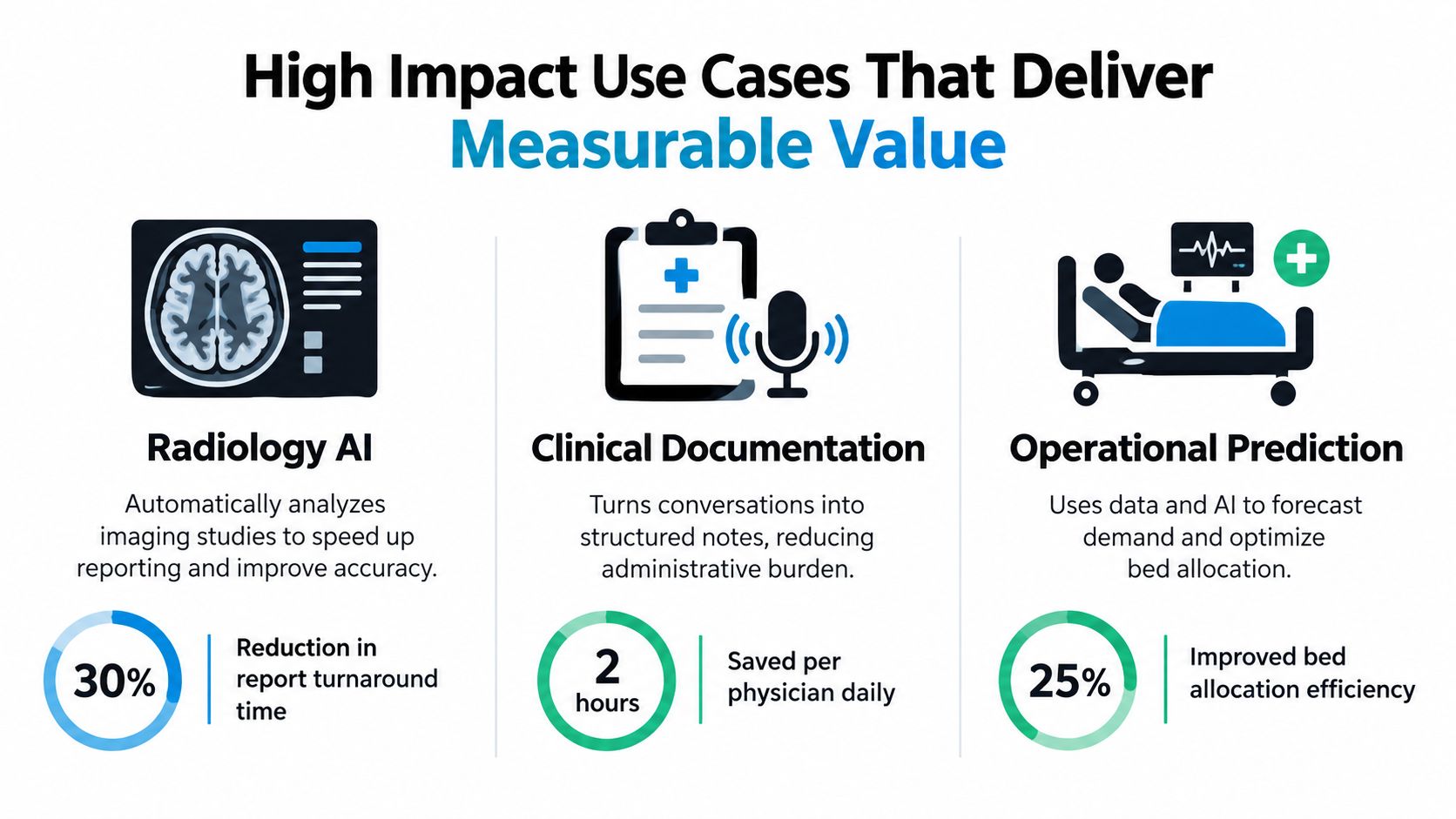
AI creates value fastest in work that is frequent, structured, and expensive to do by hand. In healthcare, that usually means imaging, documentation, triage, revenue cycle, and operational prediction. The pattern is straightforward: start where the workflow is already clear, then measure whether AI reduces effort without creating extra review burden.
The regulatory trail shows where adoption first became visible. By 2026, the FDA had authorized more than 1,300 AI-enabled medical devices, and about 76% were in radiology (FDA authorization coverage). That does not mean every health system should begin with imaging, but it does show where the first operational proof points appeared.
Where value tends to show up first
Radiology is a strong starting point because the input is structured and the output can be reviewed. Clinical documentation is another clear candidate, since clinicians spend so much time turning conversations into notes, orders, and summaries. Operational prediction can help leaders forecast demand or bottlenecks and make staffing decisions with less guesswork.
A use case is valuable because it removes friction from a real process, not because it sounds advanced. That is why real-world use cases matter more than generic AI demos, and why AI tools for business should be judged by workflow fit, not novelty.
How to prioritize without getting distracted
Use cases usually fit into three buckets.
- Clinical efficiency: documentation, summarization, and triage support where clinicians need time back.
- Operational efficiency: bed allocation, queue management, and claims support where bottlenecks cost money.
- Clinical quality support: imaging and decision support where review and validation matter.
The best first use case is the one your team can measure inside the existing workflow.
For healthcare product teams, that often means pairing a visible frontline problem with a narrow implementation path. One example is an engagement assistant that supports patient outreach and follow-up. For patient outreach, see the HCP Engagement Co-Pilot for embedded engagement workflows. Ekipa AI's internal tooling can also help when the goal is to build AI into the product instead of bolting it on.
Technical Architecture for Scalable Healthcare AI
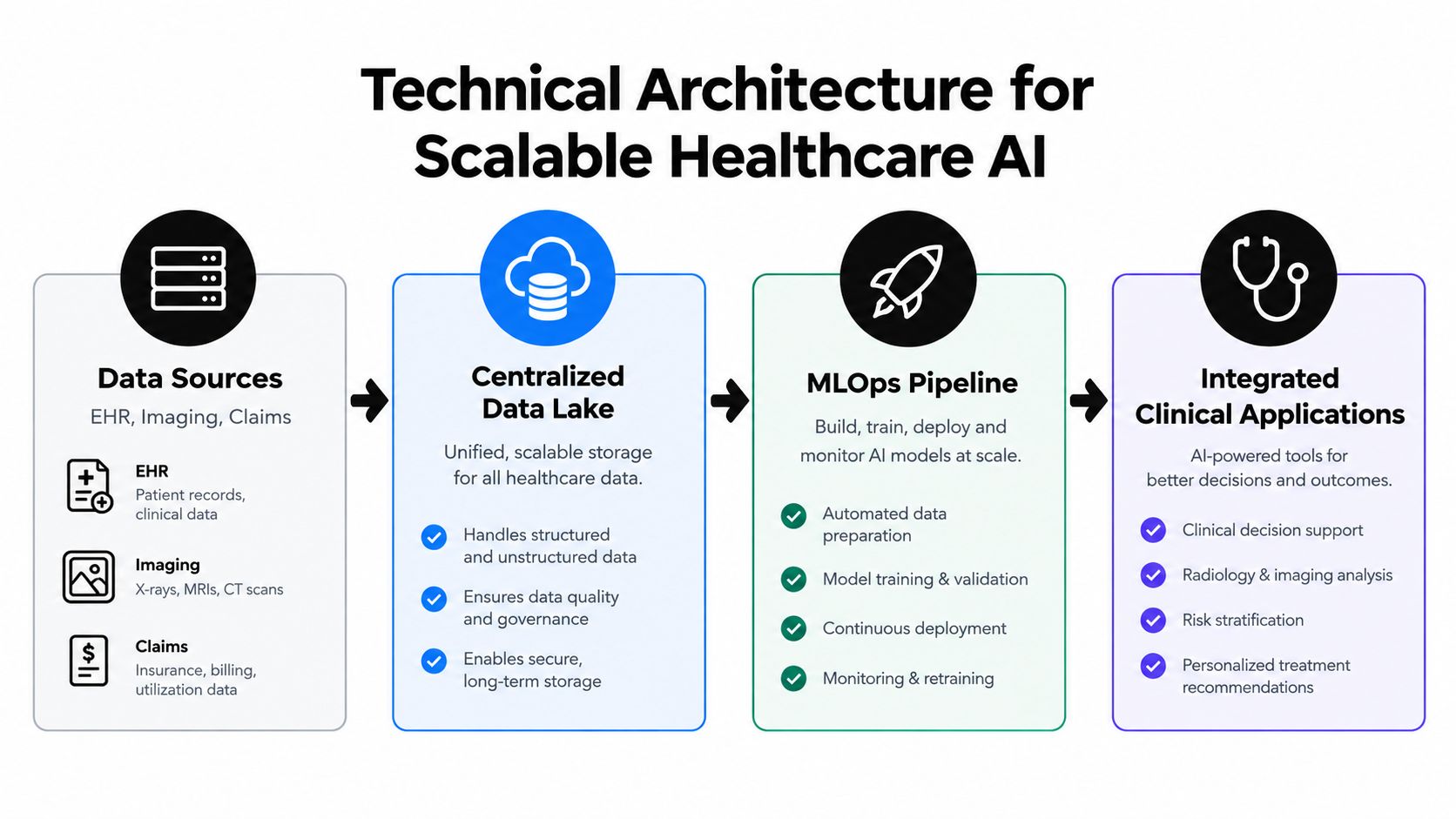
Healthcare AI scales from infrastructure, not from a model demo. If data comes from different systems with different definitions, even a strong model will behave inconsistently. Health systems need a structure that connects EHR data, imaging, claims, and operational sources so the same data can support training, validation, and production use.
From data ingestion to live workflow
The first layer is data ingestion, where systems pull from EHRs, imaging repositories, claims platforms, and other sources. The next layer is normalization, which maps those inputs into consistent fields and clinical definitions. The last layer is deployment and monitoring, where the model runs inside a service that can be observed, updated, and rolled back if needed.
MLOps gives that stack operational discipline. It supports version control, drift monitoring, change testing, and audit trails, so each update is handled like a managed release instead of a one-off engineering task. Teams can operationalize this with the AI Delivery Framework for versioning, monitoring, and rollback.
Where EHR integration changes the work
EHR integration is the point where AI becomes part of the care flow instead of a separate tool. That usually requires APIs, event triggers, structured templates, and clear handoffs back to the user. If a clinician has to leave the system to use the AI, adoption drops quickly.
custom healthcare software development fits when off-the-shelf tools do not match workflow-specific needs. In regulated use cases, SaMD solutions may fit better when software moves closer to a medical function.
Engineering takeaway: if the system cannot explain what it saw, what it changed, and who reviewed it, it is not ready for healthcare scale.
AI Automation as a Service fits repeatable tasks inside a defined workflow, but it still needs architecture for data access, review, and failure handling. A strong AI requirements analysis should come before any build decision, because the architecture should follow the problem, not the other way around.
Compliance Governance and Trust by Design
A healthcare AI system can be fast and still fail adoption if people cannot trust its behavior. Clinicians need to know what it is doing, compliance teams need evidence they can audit, and leaders need a defensible record when something goes wrong. Governance is part of the operating model, especially in workflows that touch documentation, patient communication, or decision support.
A useful reality check is the deployment gap around explainability. In one systematic review, only 28% of clinical AI tools produced interpretable outputs, and adding explainability features increased diagnostic accuracy by 25% and clinician trust scores by 35 points (systematic review of clinical AI implementation). Transparency changes adoption quality, not just user comfort.
What trust by design looks like in practice
Trust by design means people know when AI is being used, what it is allowed to do, and how its output is checked. It also means the organization can trace decisions after the fact. That requires review workflows, logging, role-based access, and post-deployment monitoring from day one.
Recent implementation research points in the same direction. Health systems are dealing with concerns about bias, hallucinations, and misinformation, and many clinicians validate AI-generated outputs before using them. State AI laws have also raised scrutiny on prior authorization and patient communications, especially where human review and disclosure are required (Wolters Kluwer future-ready healthcare report).
Governance is a product requirement
Compliance cannot sit in a separate lane from engineering. HIPAA, FDA SaMD pathways, state AI rules, and internal policy all shape the final product. If you build the workflow first and add governance later, the result is usually rework across the stack.
A strong regulatory compliance partner can help when teams need specialized oversight on documentation, auditability, and deployment controls. AI strategy consulting is useful when the organization needs a shared framework for what is acceptable, what is measurable, and what must stay human-reviewed.
Your Adoption Roadmap From Pilot to Scale
The cleanest adoption path starts with one use case, one owner, one workflow, and one clear measure of success. If a pilot cannot hold those four pieces together, it is not ready for scale.
Many health systems still have pilots without an operating rhythm. One team tests a scriber, another tests triage support, and a third starts a claims workflow project. Each group uses a different scorecard, so leaders cannot compare results or decide where to invest next.
A practical sequence
- Select a narrow use case. Start with a workflow that has clear volume, clear pain, and clear measurement.
- Define the target operating model. Decide who owns the process, who reviews outputs, and what gets escalated.
- Build the implementation path. Use a structured Custom AI Strategy report to connect the use case to data, workflow, and governance needs.
- Validate before expanding. Measure accuracy, adoption, cycle time, and exception handling in the live environment.
- Scale only after the handoffs are stable. Growth should follow repeatability, not enthusiasm.
The middle of that sequence often needs hands-on support. Our expert team can help connect product, engineering, and healthcare operations without splitting ownership across too many groups.
If the pilot depends on heroics from one clinician or one engineer, it is not a platform yet.
A useful reference point for leadership teams is an AI legal assistant for business owners, especially when the adoption path raises questions about policy, risk, or internal documentation. Legal support does not replace product judgment, but it keeps decisions visible and auditable.
Common Pitfalls and How to Measure Success
The biggest AI mistake in healthcare is treating pilot count as progress. Fragmented data, weak governance, and misaligned incentives slow teams down. Progress shows up when one workflow changes in a controlled, measurable way.
The maturity gap is still real. One 2026 industry survey found 65% of organizations rank AI and automation as their top investment priority, yet 59% are still in early or developing AI maturity and 64% say the domain remains underfunded and fragmented across silos (emids healthcare AI survey). Interest is high, but operating-model readiness is lagging.
What to measure
Measure adoption, not just launch. Measure accuracy, not just model confidence. Measure cycle time, exception rates, and clinician override behavior where those metrics apply. If a workflow gets faster but trust drops, the program is failing in a different way.
A practical scorecard answers four questions.
- Did people use it? Adoption should show up in the live workflow.
- Did it help? Look for less manual effort or faster turnaround.
- Did it stay safe? Track errors, overrides, and escalation patterns.
- Did it scale cleanly? Reusable architecture matters more than one-off wins.
The harder mistake is assuming a tool can solve an operating-model problem. Healthcare teams often need process ownership, data access rules, and review paths before AI can move beyond a proof of concept. For leadership alignment on governance and ROI, see AI strategy consulting for a fractional CAIO model.
If a pilot depends on heroics from one clinician or one engineer, it is not a platform yet. The goal is a governed program that can absorb handoffs, fit into EHR-connected workflows, and show value without relying on exceptions.