AI in Healthcare
EHR Integration Software: A 2026 Buyer's Guide
Compare 10 EHR integration software options, from FHIR platforms to integration engines, with use cases, trade-offs, and selection guidance for healthtech
September 25, 2026Read more
Learn HIPAA compliance for software development with practical guidance on safeguards, risk assessments, audit logging, and breach response built into the SDLC.
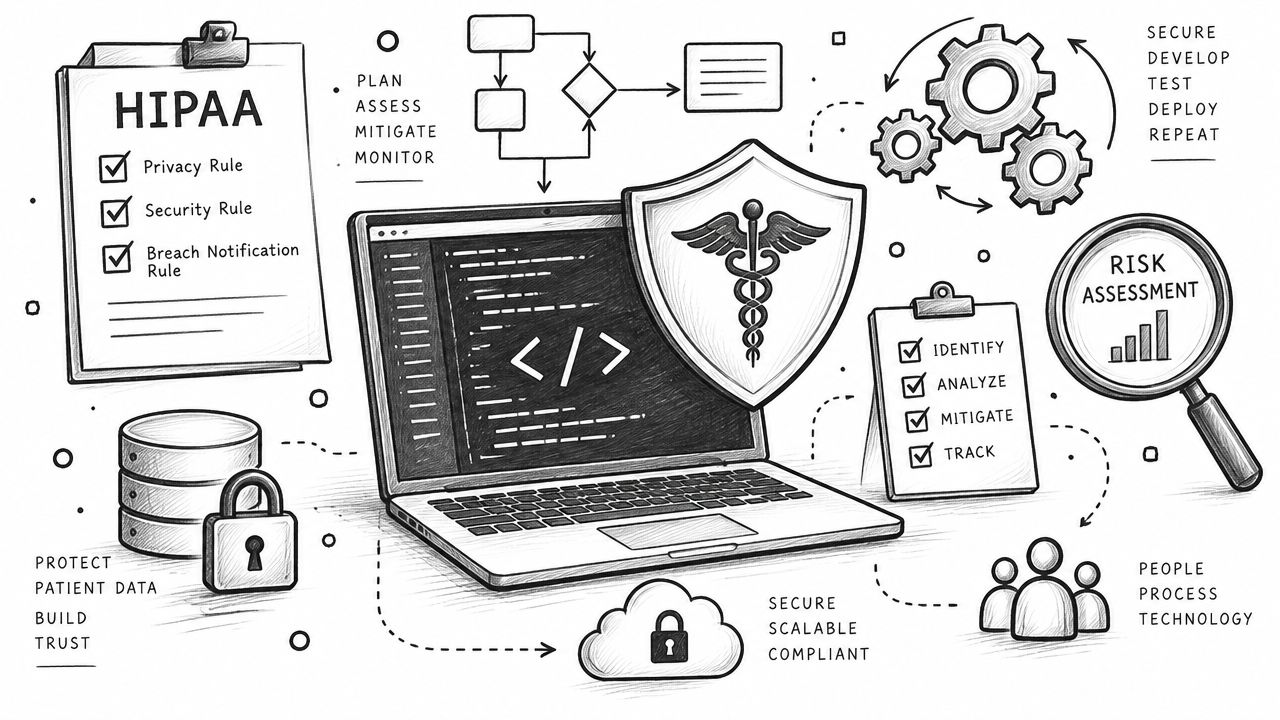
You've got a patient intake app working, a BAA signed, and a launch date that's close enough to feel real. Then the security review lands, and every shortcut in auth, logging, and data flow turns into a liability question. That's the moment teams learn that hipaa compliance for software development isn't a legal stamp at the end. It's a design constraint that has to shape the product from the first ticket to the last deploy.
HIPAA's own timeline explains why. The Security Rule was published in February 2003 and became mandatory for most organizations on April 20, 2005, with small health plans following on April 20, 2006, and it established the baseline for the confidentiality, integrity, and availability of ePHI. The Breach Notification Rule then took effect on September 23, 2009, and created the operational pressure that still defines software design today, including the 60-day notice clock for affected individuals and HHS reporting for breaches involving 500 or more people. In practice, that means compliance lives in architecture, code review, monitoring, and incident response, not in a binder that gets signed once and forgotten. HHS HIPAA security guidance
A four-engineer startup can ship a polished patient intake app and still be nowhere near safe to launch. The signed BAA gives the team permission to process PHI on behalf of a covered entity, but it doesn't answer the critical questions, such as who can see which fields, where audit events go, and how fast a compromised session dies. Those decisions have to be baked into the SDLC, because by the time a security review starts two weeks before launch, the wrong model is already embedded in the code.
The healthier pattern is simple. PHI gets identified at ticket intake, authorization rules get designed before endpoints exist, and logging is treated as a product requirement instead of an afterthought. That's the difference between “we'll secure it later” and “the system can't leak by default.”
Practical rule: if a feature touches PHI, the acceptance criteria should mention data scope, access scope, logging scope, and failure behavior.
The same mindset applies to design reviews and testing. If engineers wait until the end, they end up retrofitting controls around already-shipped assumptions, which is where avoidable breach exposure shows up. If they build the controls early, security review becomes validation, not a rescue mission.
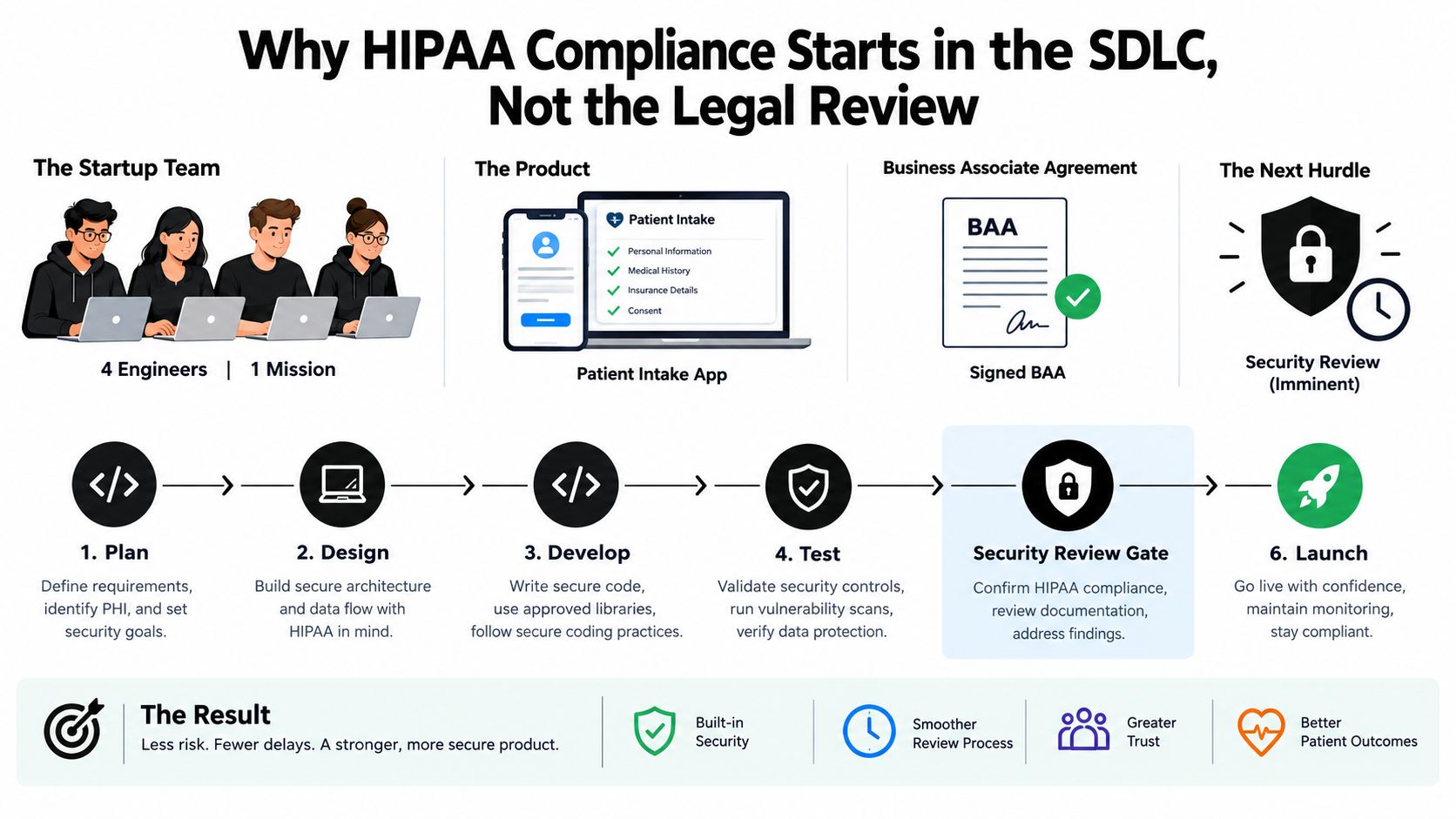
A good healthtech team treats this like product work. Requirements define minimum necessary data, design defines trust boundaries, coding defines enforcement, testing proves the controls exist, deployment locks the environment down, and operations keep the system from drifting. If you want a partner that works in that style, the healthcare practice at Healthcare AI Services sits in that same discipline-first lane.
HIPAA isn't one rule. For software teams, the useful split is between the Privacy Rule, the Security Rule, and the Breach Notification Rule. Each one maps to a different set of product decisions, and each one creates a different kind of failure if you ignore it.
The Privacy Rule governs what data you collect, how much of it you expose, and how patients can exercise rights like access, amendment, and accounting of disclosures. That turns into export endpoints, correction workflows, redaction logic, and minimum-necessary access checks. If your API can dump a patient record to anyone with a stale token, that's not just bad UX, it's a privacy problem.
The Security Rule is the architecture rule. It requires administrative, physical, and technical safeguards, which is why hosting choices, access control design, device hygiene, and network segmentation all matter. The Breach Notification Rule is the incident rule. It creates the 60-day notification clock and the downstream reporting duties that need to be reflected in your runbooks, your contracts, and your alerting.
| HIPAA Rule | Engineering Responsibility | Code-Level Examples |
|---|---|---|
| Privacy Rule | Limit data exposure and support patient rights | Export jobs, redaction filters, consent flags, correction workflows |
| Security Rule | Protect ePHI across systems and environments | RBAC, encryption, session controls, audit logging |
| Breach Notification Rule | Detect, preserve, and report incidents quickly | Alerting, incident timelines, evidence retention, breach triage |
Classification matters too. A covered entity is the healthcare organization directly providing care or paying for it, while a business associate is the vendor creating, receiving, maintaining, or transmitting PHI on its behalf. If your software team is building for a hospital or clinic, the software company is usually the business associate, which is why the BAA and the resulting technical obligations land on the vendor side as well as on the client side.
The word addressable causes a lot of bad engineering behavior. People read it as optional, then act surprised when an auditor asks for the control or the documentation explaining the alternative. In HIPAA, addressable means you have to assess, implement, or justify a reasonable equivalent. It does not mean “skip it and hope nobody notices.”
Required specifications are the hard line. If your system stores or processes ePHI, those controls are essential in practice, even when a team tries to hand-wave them away. Unique user identification, for example, is not something you can replace with a shared service account because it's convenient.
Addressable specifications demand a decision and a record of that decision. Automatic logoff is a common example. A team can configure a 15-minute idle timeout, choose a different value based on clinical workflow, or document why an alternative is reasonable, but they can't leave the issue unexamined.
If it's addressable, the decision belongs in an ADR, a ticket, or a risk acceptance memo. If it only exists in someone's head, it doesn't exist for audit.
That distinction changes daily work. A developer who proposes role-sharing for backend access to PHI needs to explain how unique identity and accountability are preserved. A product manager who wants a longer session window needs to understand the trade-off between convenience and exposure. The control and the paper trail travel together, because both are part of the implementation.
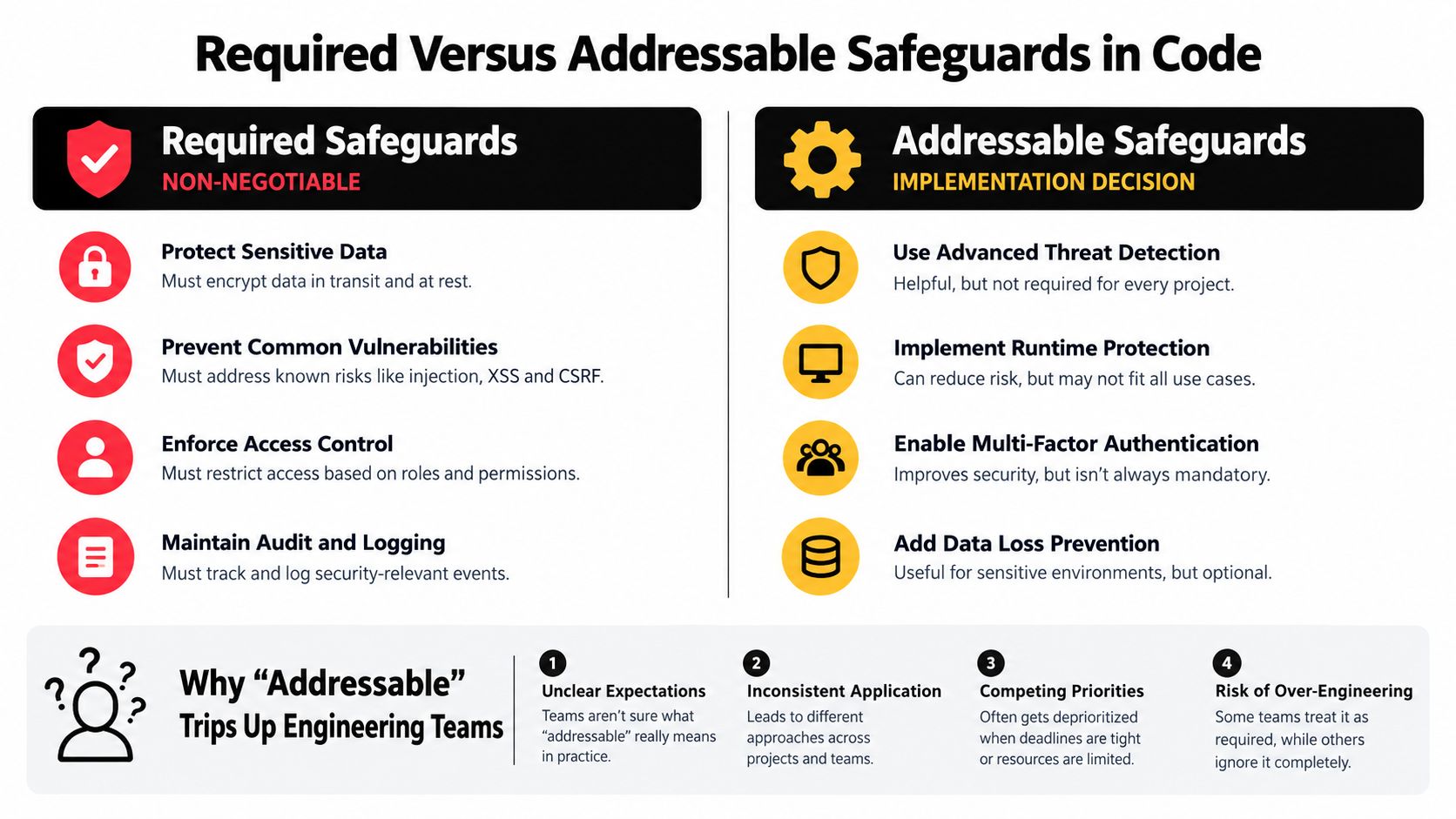
That's why “addressable” never belongs in a backlog item without a decision path. If the team can't explain why a control was implemented, substituted, or deferred, the system is still exposed, and the audit trail is incomplete.
The Security Rule's technical safeguards are where compliance becomes software. The practical translation is less glamorous than a policy deck, but it's the part engineers own: identity, logging, integrity, authentication, and transport security. If those five pieces are weak, the rest of the program is just paperwork with a cloud bill.
Access control starts with unique user IDs and role-appropriate access. Shared accounts make attribution impossible, and attribution is what you need for both incident response and audit readiness. Automatic logoff, emergency access procedures, and least-privilege service identities belong in the same design conversation, because they all reduce the blast radius when something goes wrong.
Audit controls need to record meaningful actions, not just raw requests. Log who accessed which record, when they did it, what they changed, and whether the action succeeded. The logs should be tamper-evident and stored separately from the main application data, because a good attacker will go after the record of their own activity as soon as they find it.
Integrity controls are what stop a record from being altered. That can be database constraints, versioning, checksums, or a domain-specific tamper check, depending on the system. Transmission security means PHI moves over protected channels, not over ad hoc service paths that happen to be “internal.” If your app leaks patient data through a broken object-level authorization path, the encryption layer won't save you.
For teams looking for a more structured build process, SaMD solutions are one place where compliance-minded delivery has to be visible in the architecture itself, not added as an afterthought.
A useful external reference for broader application security testing is 2026 app security best practices, especially when you're aligning security scans with release gates and not treating them as a once-a-quarter ritual.
Before merge, engineers should verify four things every time. The first is that no PHI appears in logs or client-side error payloads. The second is that keys are managed outside the app. The third is that every PHI-bearing endpoint enforces authorization at the object level, not just at the route level. The fourth is that service identities cannot see more than they need.
A risk assessment should live with the architecture, not in a separate compliance folder. The useful output is a living map of assets, data flows, threats, and controls, which means the engineering team can update it when the product changes instead of waiting for a yearly review that's already stale. HHS guidance on risk analysis also ties encryption decisions to the Security Rule's technical provisions, which is another reason the assessment belongs close to design work. HHS risk analysis guidance
Start with a data flow diagram. Mark where PHI is created, where it's stored, where it moves between services, and where it's destroyed or archived. Then run a lightweight threat model on each trust boundary, whether you use STRIDE or a simpler variant, and write the result into a repo-based risk register the team can maintain.
Realistic threats are usually boring. A misconfigured storage bucket, a contractor laptop with prod credentials, or a logging library that serializes PHI can all create serious exposure without any dramatic attack chain. The point of the register is to force those issues into the open while changes are still cheap.
| Asset / Data Flow | Threat Scenario | Likelihood | Impact | Mitigation | Owner | Status |
|---|---|---|---|---|---|---|
| Patient intake API | Broken object-level authorization exposes another patient's data | Medium | High | Enforce per-record checks, add auth tests | Backend lead | Open |
| Event log pipeline | PHI is accidentally written into logs | Medium | High | Redaction middleware, log review rules | Platform engineer | In progress |
| Admin export job | Unauthorized bulk download of records | Low | High | Approval workflow, scoped access, alerting | Security lead | Open |
Risk acceptance belongs with someone who can accept the business trade-off, not with the developer who wrote the code. A security officer or equivalent owner should sign off on unresolved items, and that decision should be visible in the repository history or a linked decision record. That gives the team one place to check when the product changes and the control needs to be revisited.
The breach clock starts when discovery happens, not when the incident review finally wraps up. Under the Breach Notification Rule, affected individuals must be notified without unreasonable delay and no later than 60 days after discovery, and covered entities must report certain breaches to HHS in the same window. That deadline is short enough that response quality depends on preparation long before an incident exists. HIPAA breach notification guidance
The first 24 hours are where engineers can still shape the outcome. Containment comes first, then key rotation, token revocation, log preservation under legal hold, and a careful decision about what to wipe and what to isolate. A compromised dev laptop and a compromised production database are not the same event, and treating them the same usually destroys evidence or leaves exposure active.
Encrypted ePHI can also change the reporting posture. HHS states that properly encrypted ePHI generally falls within safe harbor because encrypted data is not considered unsecured, which can materially reduce notification exposure when the key material stays protected. That makes key management a legal control as much as a technical one.
HHS sample BAA language also expects the business associate to report breaches of unsecured PHI and security incidents it becomes aware of, so incident reporting isn't just a courtesy between vendors. It's part of the contract structure that supports the operational response.
A breach runbook is only useful if someone has already rehearsed it, owns it, and can reach the right people at 2 a.m.
Before launch, the team should already have dashboards for security events, an escalation path that reaches legal and security leadership, and a preserved evidence workflow that won't overwrite its own trail. If those pieces are missing, the incident response plan is just a document with no execution path.
A two-week sprint for a patient-facing appointment feature sounds routine until you map the compliance work onto it. The team starts with architecture review, confirms the minimum necessary fields, and chooses per-tenant encryption keys before a single repository change lands. They also pin every third-party service that will touch PHI to the BAA-covered list, because that decision affects both the data path and the vendor chain.
Mid-sprint, the backend team reviews the authorization path and writes tests for object-level access. The product owner approves MFA and session timeout as release requirements, because those are user-visible behavior with real risk implications. In CI, the pipeline blocks commits that contain seeded PHI, and staging data gets scrubbed before QA touches it.
The release candidate then gets a signed-off pen test, not as a ceremonial step but as a final check for authorization gaps, exposure in logs, and weak session handling. After deploy, the team verifies audit log retention, SIEM ingestion, and the on-call hooks that would be used if an access anomaly shows up after hours.
That kind of sprint is what compliance looks like when it is engineered by design. It's not a separate phase. It's a set of decisions that shape what gets built, what gets blocked, and what gets shipped.
The same delivery discipline is what AI Product Development Workflow work depends on when regulated software has to be planned, reviewed, and deployed without losing control of the data path.
The first compliance break after launch is often quiet. A subprocessor changes, a new analytics tool touches PHI, an access role expands, or someone copies a production payload into a test fixture because it feels temporary. Each choice looks small in isolation. Together, they can break the control story fast if nobody is actively checking what changed.
BAAs need review and re-scoping whenever vendors change. Incident-reporting clauses also need a current contact path, because an old security alias is not a response plan. Dev and test environments need strict data hygiene so production PHI never lands in local snapshots, sample databases, or screenshots.
Audit-log retention has to stay intact, along with regular access reviews tied to RBAC diffs. Dependency scanning matters because a vulnerable package in a PHI path still opens a route into the system, even if the application code is sound. Tabletop drills should rehearse the 60-day breach clock, because a runbook only helps when the team has practiced using it under pressure.
A sustainable program leaves evidence behind. Policy-as-code belongs in the repo, evidence packs need to be easy to assemble, and risk-acceptance decisions should have a changelog instead of disappearing into Slack. That makes the system reviewable by engineers, auditors, and operators without forcing anyone to reconstruct intent from memory.
For teams that need a broader build-and-governance model, AI Automation as a Service, internal tooling, and AI tools for business show how workflow design and controlled access can work together when governance is treated as a product requirement, not a cleanup task.
If you're building a healthcare product and want compliance handled as part of engineering, Ekipa AI works on healthcare software, AI delivery, and implementation support with privacy, security, and auditability built into the architecture.
No. It's a continuing operating discipline. BAAs change, vendors change, threat surfaces change, and the controls have to be reviewed as the product evolves.
Yes. Development and test environments should not contain production PHI, and they need their own access, logging, and data-handling rules. If those environments leak, your production controls won't save you.
No. Encryption helps a lot, especially for safe harbor treatment in a breach, but it doesn't fix bad authorization, overbroad access, or PHI in logs. A secure system needs layered controls.
Shared identities and weak object-level authorization cause a lot of trouble because they make auditability and minimum-necessary access hard to prove. Logging PHI is another common failure that teams underestimate until an incident review finds it.
Usually the product team, engineering leadership, security, legal, and operations all own pieces of it. The point is to make the controls operational, not to hand the problem to one department.
If you want a team that can help shape healthcare software around privacy, access control, and auditability from the start, talk to Ekipa AI. Their work is built for regulated products, and that makes them a practical place to start if you need HIPAA-ready architecture, delivery support, or a tighter compliance process before your next release.
Compare 10 EHR integration software options, from FHIR platforms to integration engines, with use cases, trade-offs, and selection guidance for healthtech

Learn what AI transformation healthcare industry means, from EHR integration to governance, ROI, and adoption roadmap for healthtech leaders.
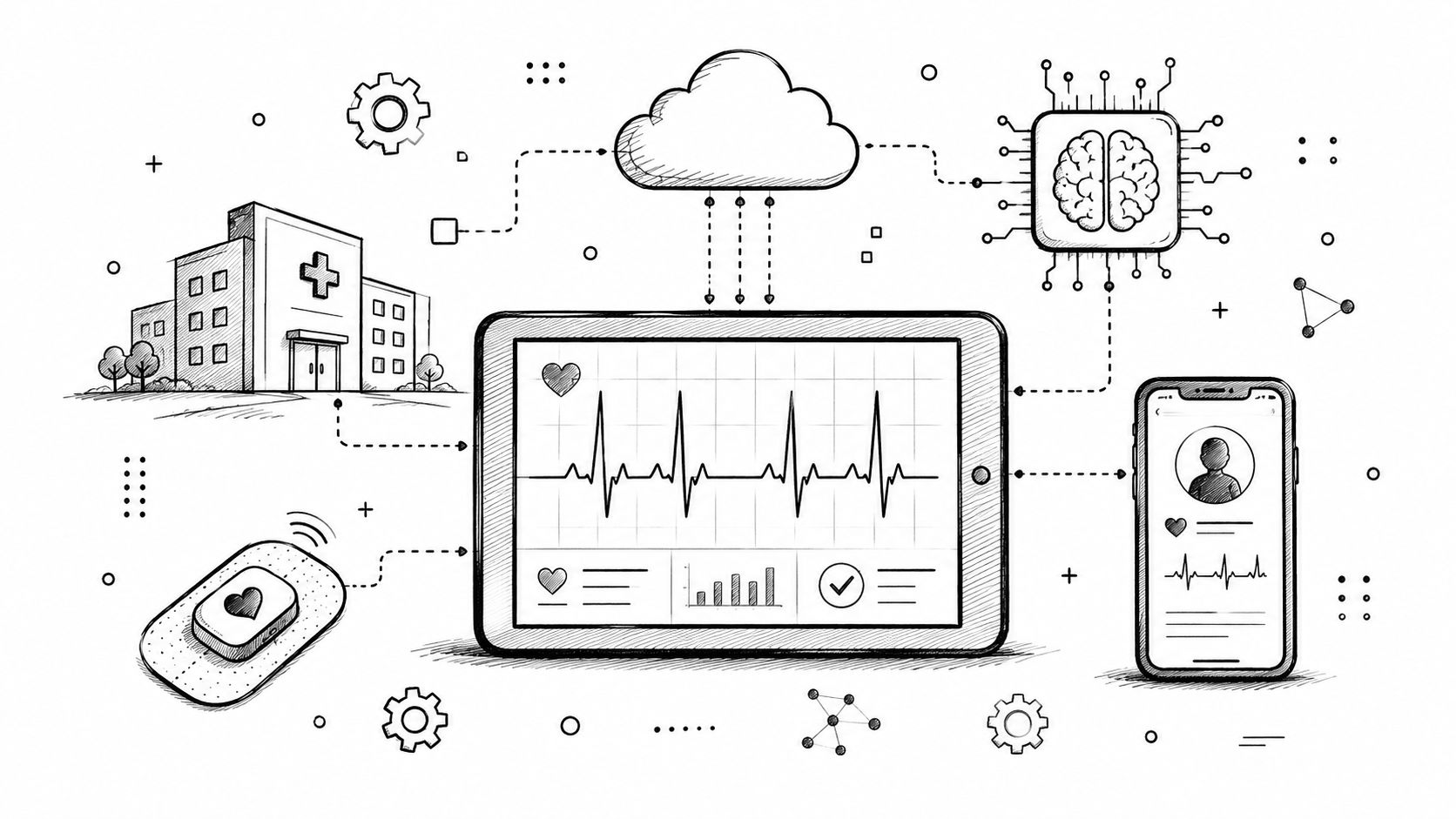
Discover how smart healthcare technology transforms patient care, reduces costs, and improves outcomes. Learn about IoT, AI, EHR integrations
Connect with our team to explore how AI expertise can transform your business.