AI in Healthcare
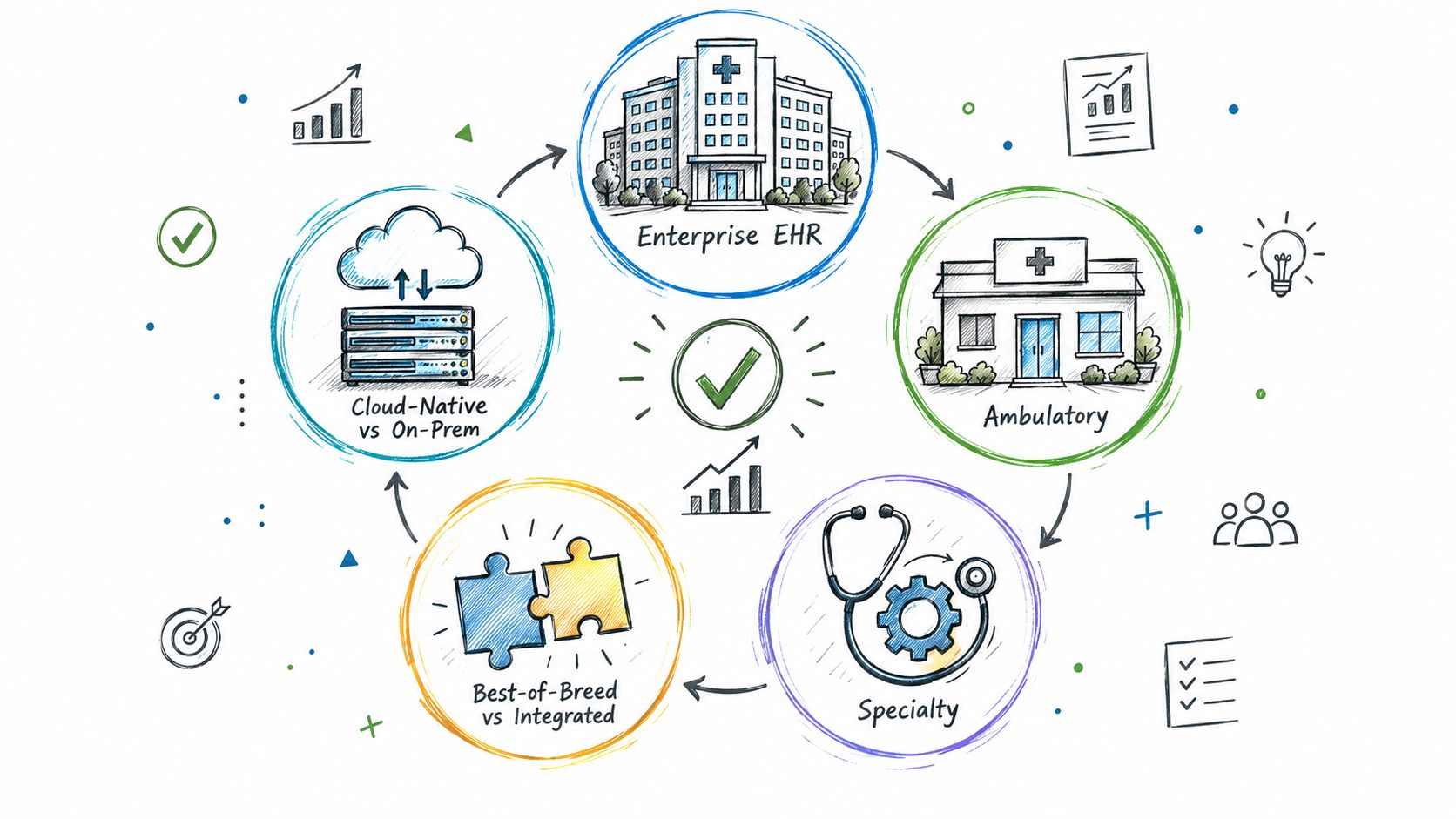
Types of EHR Systems: A 2026 Buyer's Guide
Explore the types of EHR systems by deployment model, care setting and scope. Compare integration options, trade-offs and selection tips for healthtech teams.
October 13, 2026Read more
Learn what an EMR is, how it differs from EHR and PHR, what it contains, and why it matters for healthtech teams building integrations and AI features.
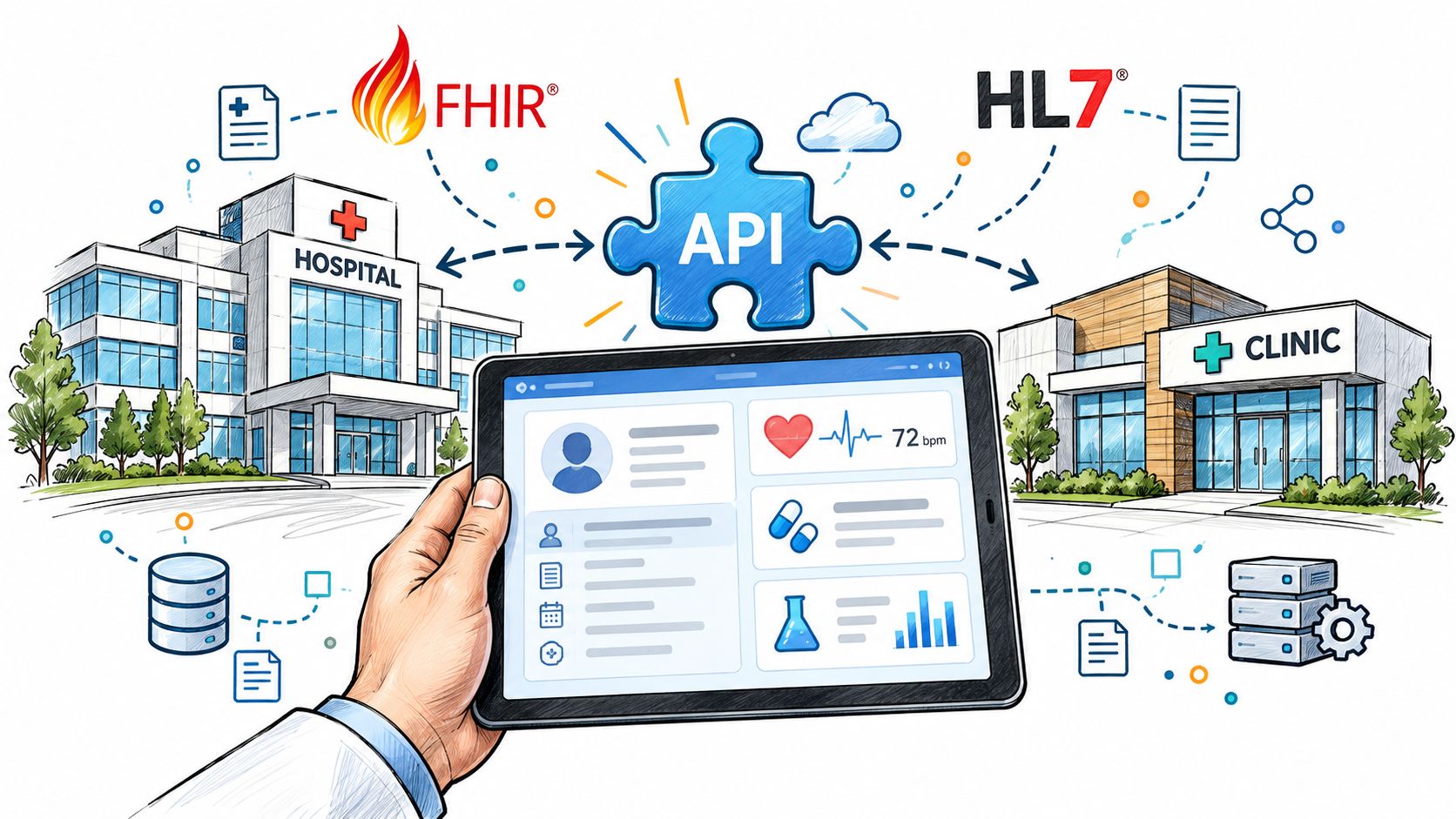
An EMR is a digital chart for a practice, while an EHR is designed to share information across providers and care settings. In the United States, only 9% of hospitals had adopted EHRs in 2008, but by May 2013 more than 80% of eligible hospitals had demonstrated meaningful use and received incentive payments, alongside more than 50% of eligible professionals.CMS adoption milestone
That history explains why the terminology can feel outdated. The engineering problem today is deciding what the system stores, how its data is coded, which interfaces the customer has enabled, and where your product must appear in clinical work. This article explains the EMR and EHR distinction, the data model, US regulatory boundaries, integration patterns, and the design choices that affect AI features.
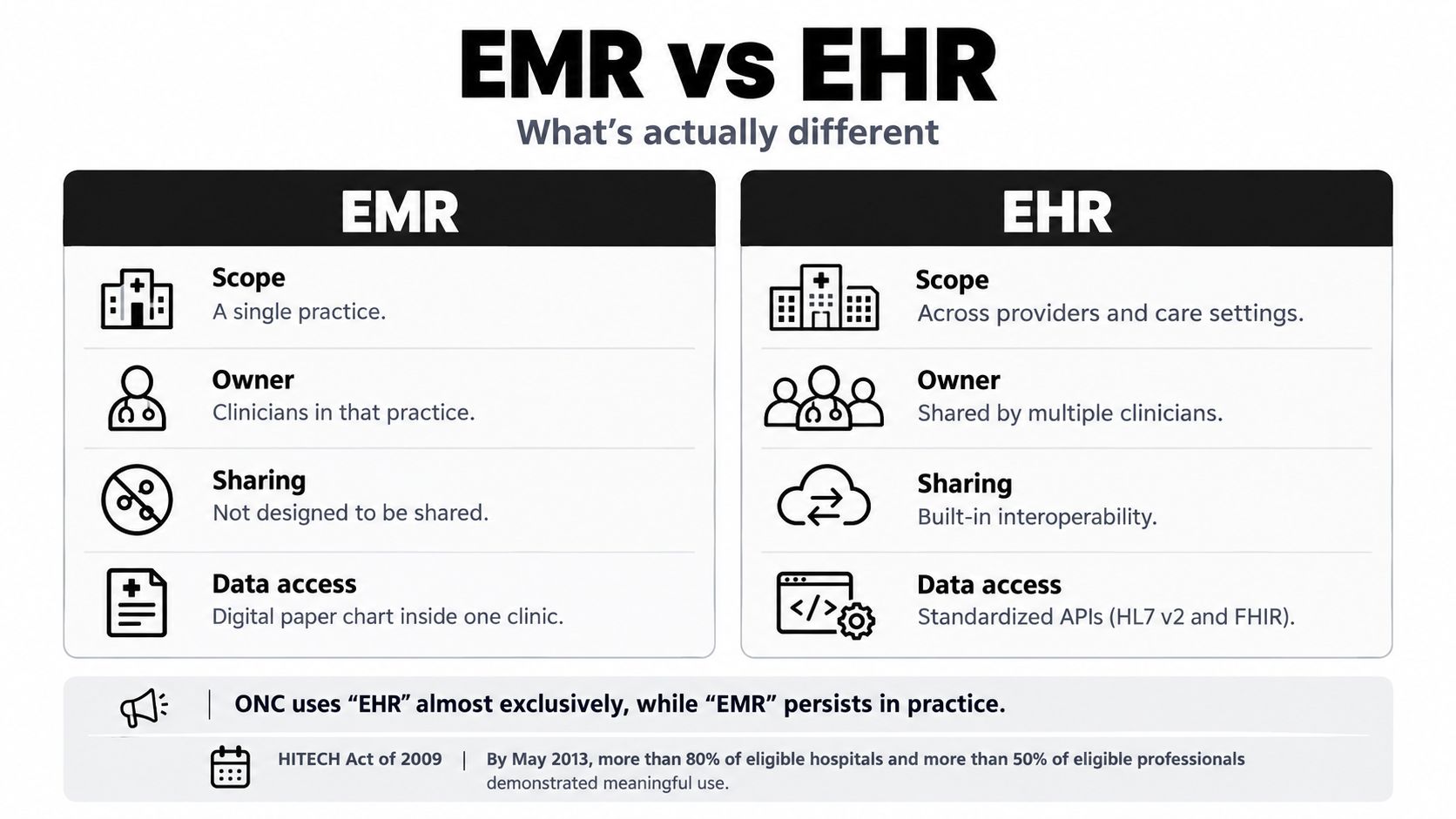
An electronic medical record, or EMR, is the digital chart a clinic uses to document care inside its own walls. The Office of the National Coordinator for Health Information Technology distinguishes that practice-centered record from an electronic health record, or EHR, which is built to support sharing across providers and care settings in its overview of EMR and EHR differences.
That sounds clean on paper. Real products are messier.
In day-to-day healthcare work, teams still say “EMR” even when the system includes patient portals, e-prescribing, lab interfaces, referral exchange, and other functions often associated with EHRs. ONC mostly says “EHR.” Vendors, operators, and implementation teams often keep saying “EMR.” The label persists because the market changed faster than the language.
The adoption curve described earlier, from early hospital uptake to broad meaningful-use participation within a few years, helps explain why the terminology now lags the technology. Federal programs pushed organizations to digitize records and exchange data, but they did not make the older label disappear. CMS adoption milestone
For a product lead or integration engineer, that means the EMR versus EHR debate is rarely the main decision. The practical question is which system serves as the system of record for the workflow you need to touch. If your feature depends on medications, orders, vitals, results, encounters, or notes, you need to know where that data originates, who can edit it, and how changes propagate.
That framing turns a naming question into an engineering one:
A platform called an EMR may still offer strong interoperability. A platform called an EHR may still limit access to the exact data and workflow your product needs. The useful boundary is the record owner, the interface surface, and the clinical step where the user acts.
The simplest comparison concerns scope, ownership, and sharing. ONC describes an EMR as a practice-centered record, an EHR as a record intended to support exchange across providers and settings, and a personal health record, or PHR, as a record managed by the patient. The ONC FAQ on PHRs, EHRs, and EMRs provides the related definitions.
| Attribute | EMR | EHR | PHR |
|---|---|---|---|
| Scope | Digital chart for a single practice | Longitudinal information designed for use across providers and care settings | Information collected and managed by the patient |
| Who maintains it | Clinicians and staff in the practice | Healthcare organizations and authorized care participants | The patient, sometimes with imported information |
| Designed to share data | Sharing may be limited or practice-specific | Sharing across organizations and care settings is a core purpose | Sharing is controlled by the patient and the product's capabilities |
| Typical users | Clinicians and staff in one practice | Providers, care teams, hospitals, clinics, and patients | Patients, families, and authorized caregivers |
| Product implication | Confirm local interfaces and export options | Evaluate standards, authorization, exchange, and workflow support | Define patient consent, import, export, and identity handling |
An EMR-style chart generally supports documentation, longitudinal lists, orders, results, and access for the patient. The exact boundary varies by product and customer configuration.
| Function | What it supports | Integration question |
|---|---|---|
| Clinical documentation and notes | Visit notes, assessments, plans, and templates | Can your product read or write notes, and under which user context? |
| Problems | Active and historical conditions | Are concepts coded, locally mapped, or written in narrative text? |
| Medications and allergies | Current therapy, history, and recorded sensitivities | Which list is authoritative, and how are status changes represented? |
| Orders through CPOE | Computerized provider order entry for tests, procedures, or referrals | Does the product create orders, observe their status, or only consume results? |
| Results | Laboratory, imaging, pathology, and other findings | Are results available as structured values, documents, or both? |
| E-prescribing | Electronic prescription workflows | Does a certified module or external service own the prescription lifecycle? |
| Clinical decision support | Alerts, reminders, rules, and recommendations | Where is advice shown, and how is the triggering context recorded? |
| Patient portal | Patient viewing, messaging, forms, and selected actions | Is access provided by the EMR, a connected application, or both? |
Several functions usually sit beside the clinical record. Practice management often owns registration, scheduling, eligibility, and front-desk work. Billing and revenue cycle systems may own claims, payment posting, denial management, and financial reporting. An integration that assumes the EMR owns all of these areas will usually miss the source of truth.
Most clinical systems organize information around patients, encounters, orders, results, and notes. A patient provides identity and demographic context. An encounter connects care to a visit, admission, or episode. Orders request an action, results record what came back, and notes capture the clinician's reasoning and documentation.
Structured fields often use recognized vocabularies. LOINC can identify laboratory observations, SNOMED CT can represent clinical concepts, and RxNorm can represent medications. These codes help software compare records, but they don't remove implementation variation.
The same symptom, test, or medication can be stored under different codes, placed in different fields, or recorded only in a narrative note at two sites. A local build may also apply its own status values, display text, units, or encounter rules. This is why a mapping specification must be based on the customer's actual data, not only on the standard claimed by the vendor.
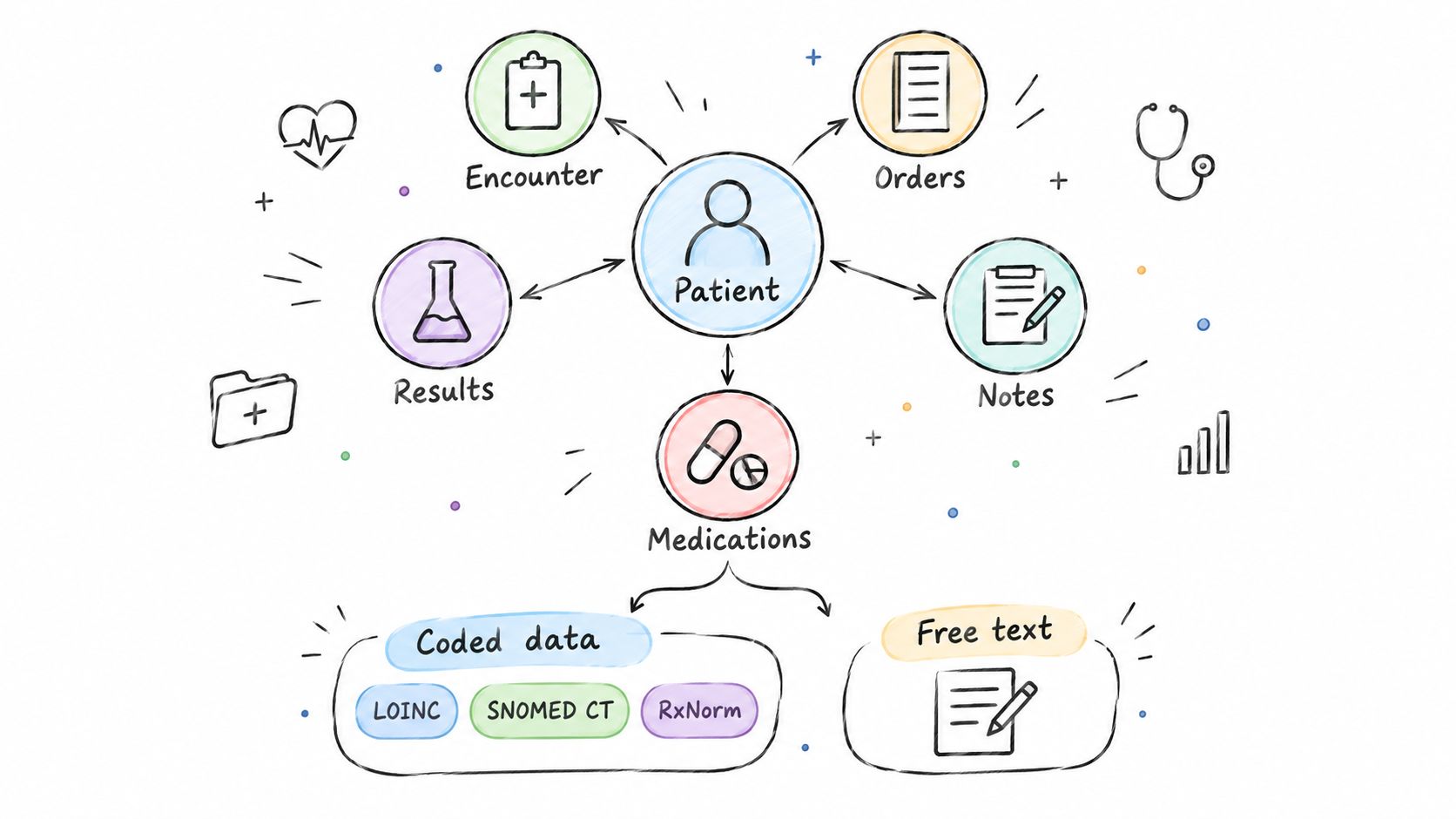
Structured data is valuable for filtering, rules, reporting, and model features. Free text contains clinical context that may not have been captured in discrete fields. Teams building extraction pipelines, including an AI-powered data extraction engine, need both paths, with provenance preserved so users can trace an output back to its source.
Inpatient EMRs support hospital operations across admissions, transfers, orders, results, medication administration, nursing documentation, and discharge summaries. The system must support multiple departments and continuous operational activity.
Ambulatory EMRs center on scheduled visits, documentation, prescribing, referrals, and reconciliation of information from outside organizations. Inpatient environments commonly depend heavily on HL7 v2 messages and interface engines, while ambulatory environments often expose patient-facing and clinician-facing FHIR APIs alongside older feeds. Those are tendencies, not guarantees, so the customer's interface inventory remains decisive.
The setting changes the integration contract. A hospital may expect ADT events, order messages, result messages, and document feeds. A clinic may prioritize SMART on FHIR launch, patient context, questionnaire workflows, and external-result review. For vendor context without ranking products, use our reference on the biggest EMR companies.
An EMR integration is shaped by more than one rulebook. For engineering teams, the useful question is not "is this EMR compliant?" but "which system is the record for this workflow, and what legal and technical constraints apply when data moves in or out?"
| Instrument | What it requires or establishes | Why it matters for product teams |
|---|---|---|
| HITECH Act and EHR incentives | Federal policy that accelerated adoption of certified EHR technology through incentive programs | It explains why certified systems became the default system of record in many provider workflows, and why exchange features are often tied to certified functionality |
| ONC Health IT Certification Program | Certification requirements for participating health IT products and functions | Certification tells you a product can meet specific criteria. It does not tell you how a given customer has configured access, identity, licensing, or write paths |
| 170.315(g)(10) | An API certification criterion for patient and population services, described by ONC in its standardized API criterion | The criterion establishes a baseline for certified API capability. It does not make each deployment operationally identical, so teams still need to map the customer endpoint to the workflow they want to support |
| 45 CFR Part 171 | Information blocking regulations governing specified practices by actors covered by the rule | Data may be technically available but still delayed, restricted, or conditioned in ways that matter to product design. The governing text is the eCFR information blocking rule |
| 45 CFR 164.312 | HIPAA technical safeguards concerning access control, audit controls, integrity, authentication, and transmission security | If software handles protected health information, the security model has to cover how access is granted, logged, verified, and protected in transit. See the HIPAA technical safeguards regulation |
This is why the EMR versus EHR label debate often distracts teams. The harder engineering question is whether your product is reading from the chart, writing into it, launching inside clinician workflow, or keeping a separate record that must reconcile with the chart later. Regulation attaches to those choices.
A certified capability can still be narrowed by local setup. A hospital may license an API module but expose only part of it. A clinic may support launch for one user group but not another. The product lead should treat certification as a starting point, then test the customer's actual endpoint and workflow path before committing scope.
Responsibility under HIPAA also depends on who does what. Teams should document who provisions credentials, who reviews audit events, who approves access, and who handles incidents. In our healthcare engineering work, those ownership decisions are part of integration design, not paperwork saved for the end.
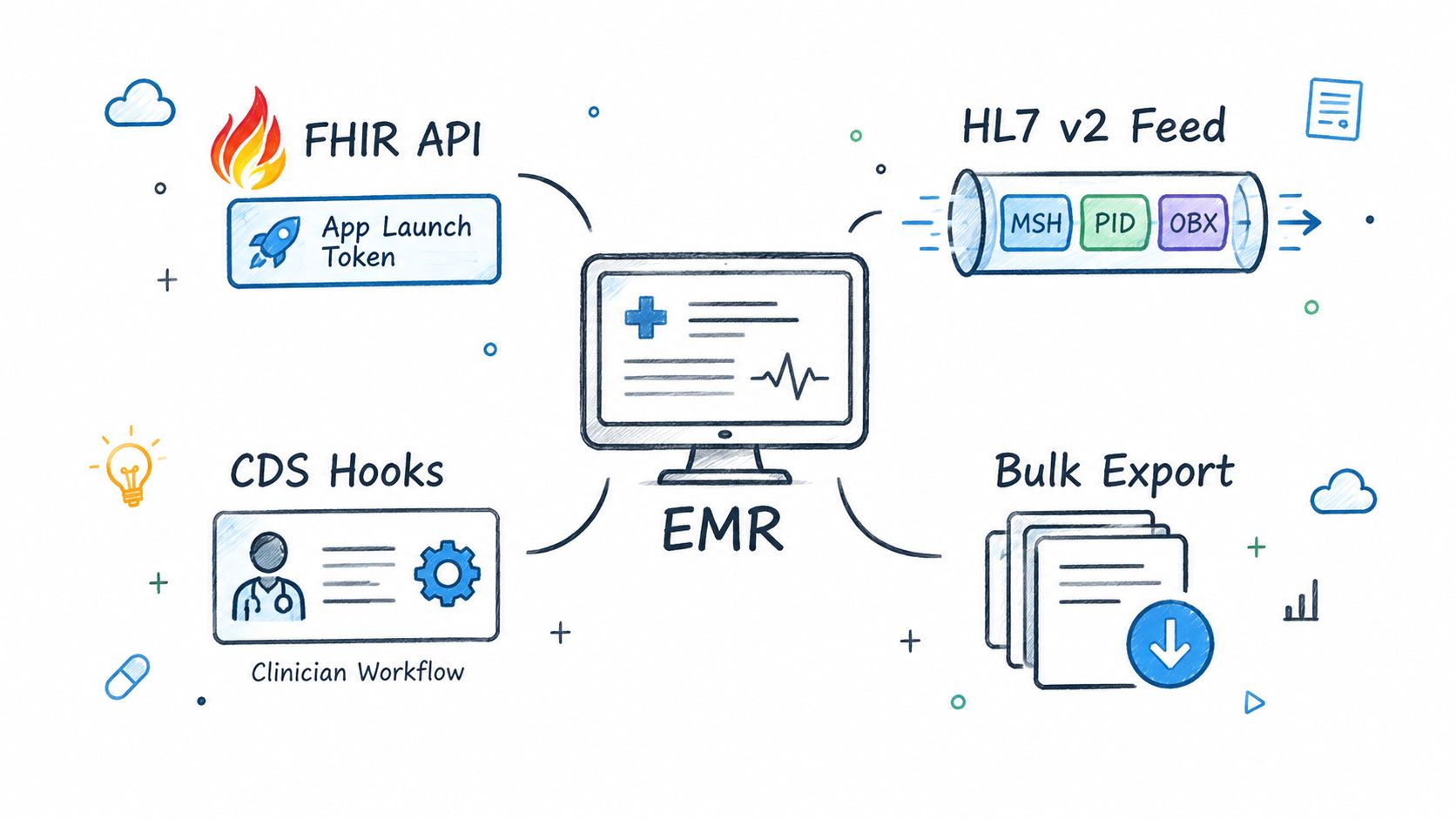
No single interface fits every workflow. The choice depends on whether the product needs synchronous lookup, event delivery, in-workflow guidance, or population-scale extraction.
| Method | Typical use | Limits to know |
|---|---|---|
| FHIR APIs with SMART on FHIR | Patient-context applications, reads and writes, app launch, and scope-based authorization | Resource coverage, write permissions, profiles, terminology, and customer configuration vary |
| HL7 v2 feeds through an interface engine | ADT, orders, results, and other event-driven exchanges | Segment usage, local extensions, acknowledgments, routing, and operational ownership differ by site |
| CDS Hooks | Decision-support services invoked from a clinician workflow | The host must support the relevant hook and provide enough context for a useful response |
| Bulk export | Population analysis, migration, reporting, and research workflows | Data arrives in larger extracts, and reconciliation, provenance, and refresh handling remain engineering work |
FHIR is an access layer, not a guarantee that every required concept is present or semantically complete. HL7 v2 can be effective for event delivery, but two sites may implement the same message type differently. Teams should define test fixtures, negative cases, retries, acknowledgments, and reconciliation before production.
The EHR integration API reference covers the mechanics in more detail. For remote patient monitoring teams assessing the clinical and operational context, OneTwenty's patient monitoring research provides additional background.
Hypothetical example: a remote patient monitoring company needs device readings to appear in the EMRs used by several clinics. The product team wants clinicians to see current readings in the chart, while analysts need structured data for trends and alerts.
Where the customer's system supports the required FHIR resources and write permissions, the service can create an Observation for each reading or an agreed clinical summary. The payload should carry the patient reference, effective time, measurement code, value, unit, device context, status, and provenance needed by the receiving system.
The clinician sees the information in a structured chart element if the EMR renders that resource in a useful location. Analytics can query values without parsing a document. The trade-off is site-specific validation: one clinic may support the required profile and display behavior, while another may accept the resource but place it somewhere clinicians rarely review.
An ORU result message can pass readings through the clinic's interface engine, which maps the incoming segments and routes the result into the EMR. This can fit organizations that already operate an HL7 v2 result workflow and have an established interface team.
The data may become structured after local mapping, but the implementation effort is usually specific to each site's message profile, identifiers, routing, and acknowledgment behavior. Maintenance includes monitoring queues, handling rejected messages, and revisiting mappings when the clinic changes its interface configuration.
A PDF or clinical document can be attached to the patient chart when structured writes and result feeds aren't feasible. This usually has the lowest technical entry barrier, but clinicians must open and interpret the document, and downstream analytics cannot reliably query each measurement.
| Option | Clinician workflow | Data usability | Effort per site | Maintenance |
|---|---|---|---|---|
| FHIR Observation | Potentially integrated into structured chart review | High when profiles and coding are aligned | Moderate, based on endpoint and workflow support | Monitor API changes, authorization, validation, and display |
| HL7 v2 ORU | Fits existing result workflows | Moderate to high after local mapping | Moderate to high, based on interface-engine work | Monitor queues, mappings, acknowledgments, and routing |
| Summary document | Requires opening and reading a document | Low for individual readings and analytics | Often lower initially | Maintain document generation, filing, and retrieval behavior |
The decision rule is practical. Use FHIR Observations when the site supports the required workflow and data model. Use HL7 v2 ORU when that is the clinic's established result path. Use a summary document as a fallback when neither structured option is feasible.
AI features inherit the weaknesses of the source record. A model may receive a coded medication list, a free-text note, a scanned document, or an incomplete combination of all three. The ingestion layer must preserve source identifiers, timestamps, authorship, coding systems, units, and encounter context before the model produces an output.
A model that summarizes notes can work with narrative text, but a model that identifies medication changes needs reliable medication status and timing. A decision-support feature may need both a structured diagnosis and the supporting note. Teams should measure coverage against the intended use case and define what happens when required fields are absent or contradictory.
FHIR can expose a resource without providing every concept needed by the workflow. The review of three public-health registries found FHIR coverage of approximately 71%, 77%, and 92% of required data elements, about 80% on average.FHIR registry review That result supports a resource-level coverage test before committing to automation.
A retrieval system can combine structured resources with indexed notes and documents, but it needs access boundaries and source references. Teams evaluating retrieval architecture can review scalable RAG with Beam for infrastructure concepts, then map those concepts to their own PHI controls and deployment requirements.
An AI result that exists only in a separate dashboard competes with the chart. The product should define whether the output becomes a draft note, a task, a suggested code, a patient-specific recommendation, or a review item. Each choice changes the write-back path, user permissions, review state, and audit record.
A clinical assistant may read FHIR resources, retrieve supporting notes, generate a draft, and return it for clinician review before any chart write. A product such as a clinic AI assistant still needs customer-specific decisions about provenance, acceptance, correction, and retention.
HIPAA technical safeguards require more than an authentication screen. The implementation should establish least-privilege access, identity binding, audit events for PHI access, transmission protections, and operational review. Evidence can include access-control configurations, test results, audit samples, incident procedures, and records showing that permissions are revoked or changed when roles change.
Information blocking rules also affect product negotiations and exchange behavior. Teams should record what data was requested, which interface was available, what technical or contractual condition limited access, and who approved the decision.
AI output should remain traceable to its inputs, its generating process, and the person who reviewed or accepted it.
The EMR versus EHR label is less important than the system of record, data structure, workflow location, and available interface. Expect coded and unstructured data to coexist, treat FHIR as an access layer rather than a semantic guarantee, and design security, auditability, and information-sharing decisions into every data path.
Talk to Ekipa about mapping your clinical workflow, interface options, and AI write-back requirements before implementation begins.
An EMR is the digital chart for a single practice, while an EHR is designed to share information across providers and care settings. ONC's definitions are useful for framing the distinction, but product teams should verify actual interfaces and workflow behavior in the customer's deployment.ONC's EMR and EHR explanation
FHIR R4 Messaging uses a Bundle with type set to message, and the first resource in that Bundle must be a MessageHeader. A receiver should validate the message structure and use the MessageHeader for routing and event context before processing the remaining resources.HL7 FHIR R4 Messaging
No. ONC certification includes standardized API criteria, but supported resources, profiles, scopes, write permissions, versions, and customer configuration can differ. Certification should be treated as a starting point for verification, not proof that a particular workflow is available.ONC standardized API criterion
Start with the workflow and the system of record. Document the data elements, source identifiers, coding systems, timing, user action, write-back requirement, interface options, and evidence needed to test security and clinical behavior.
CMS identifies approval with an ending date or circumstance, denial with a specific reason, and a request for additional information as valid response outcomes. A prior-authorization integration therefore needs more than a Boolean approval field and should preserve status, termination conditions, denial rationale, and follow-up information.CMS prior-authorization API FAQ
Ekipa AI helps healthtech teams define and build clinical software, EHR integrations, and AI workflows that fit existing healthcare systems. Visit Ekipa AI to discuss your EMR data, workflow, and integration requirements.
Explore the types of EHR systems by deployment model, care setting and scope. Compare integration options, trade-offs and selection tips for healthtech teams.
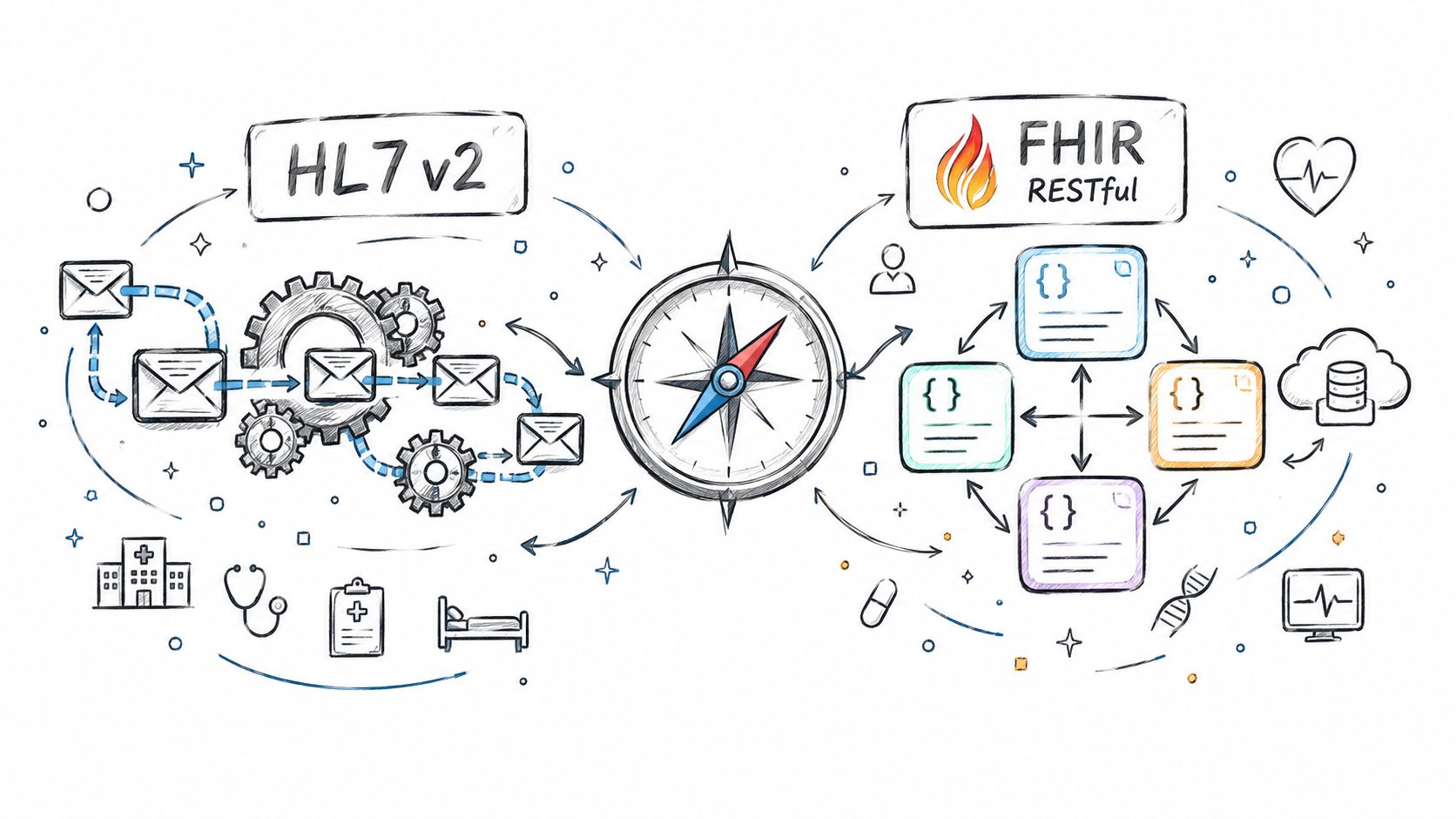
Compare Fhir vs. hl7 standards for healthtech integration. See how HL7 v2 and FHIR differ in use, mechanics, regulation, and real-world architecture.
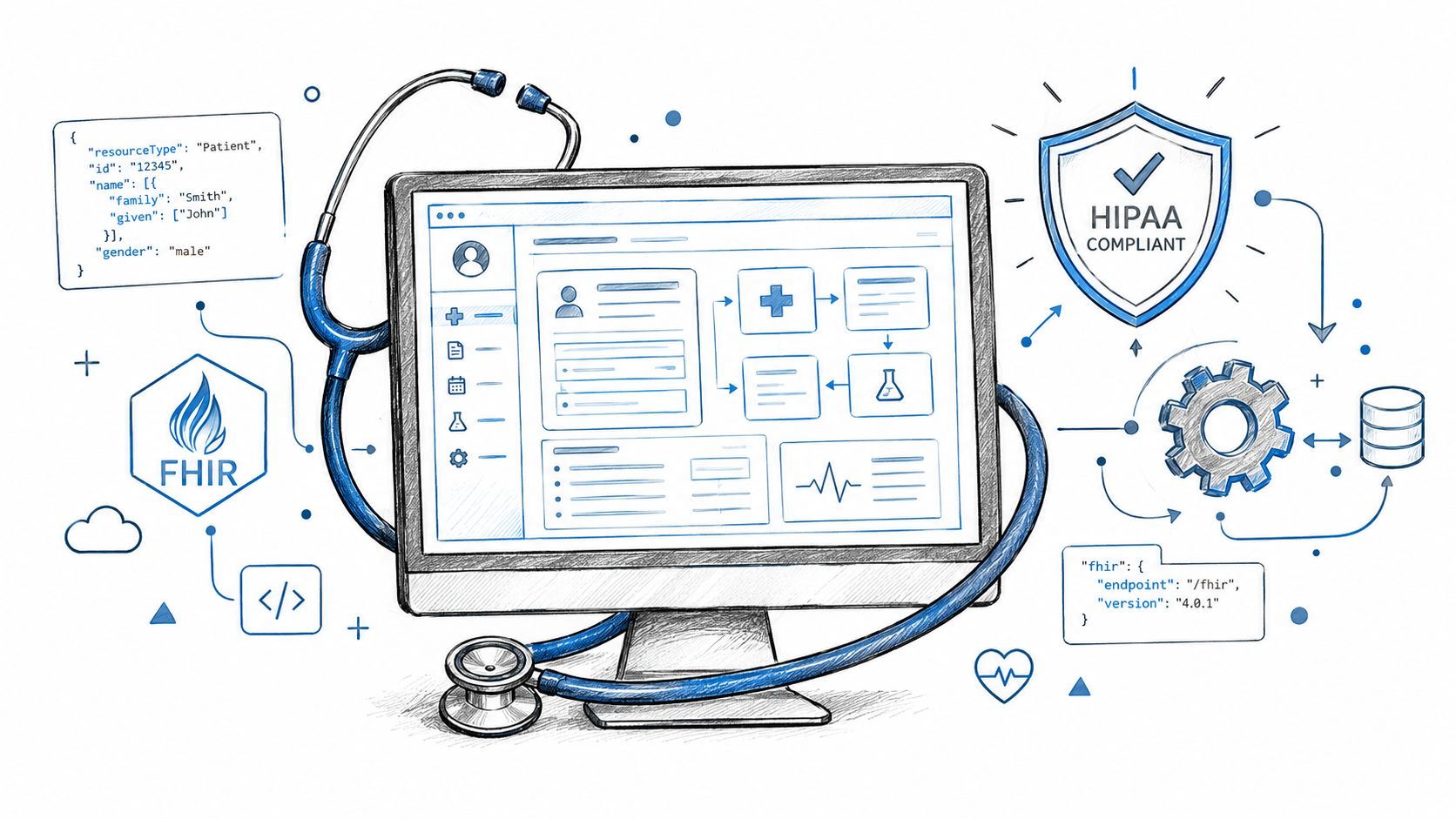
A practical EMR software development guide covering build vs extend decisions, ONC certification, FHIR integrations, and clinical workflow design.
Connect with our team to explore how AI expertise can transform your business.