
AI in Healthcare
Fhir vs. Hl7: A Healthtech Engineering Comparison
Compare Fhir vs. hl7 standards for healthtech integration. See how HL7 v2 and FHIR differ in use, mechanics, regulation, and real-world architecture.
October 12, 2026Read more
Explore the types of EHR systems by deployment model, care setting and scope. Compare integration options, trade-offs and selection tips for healthtech teams.
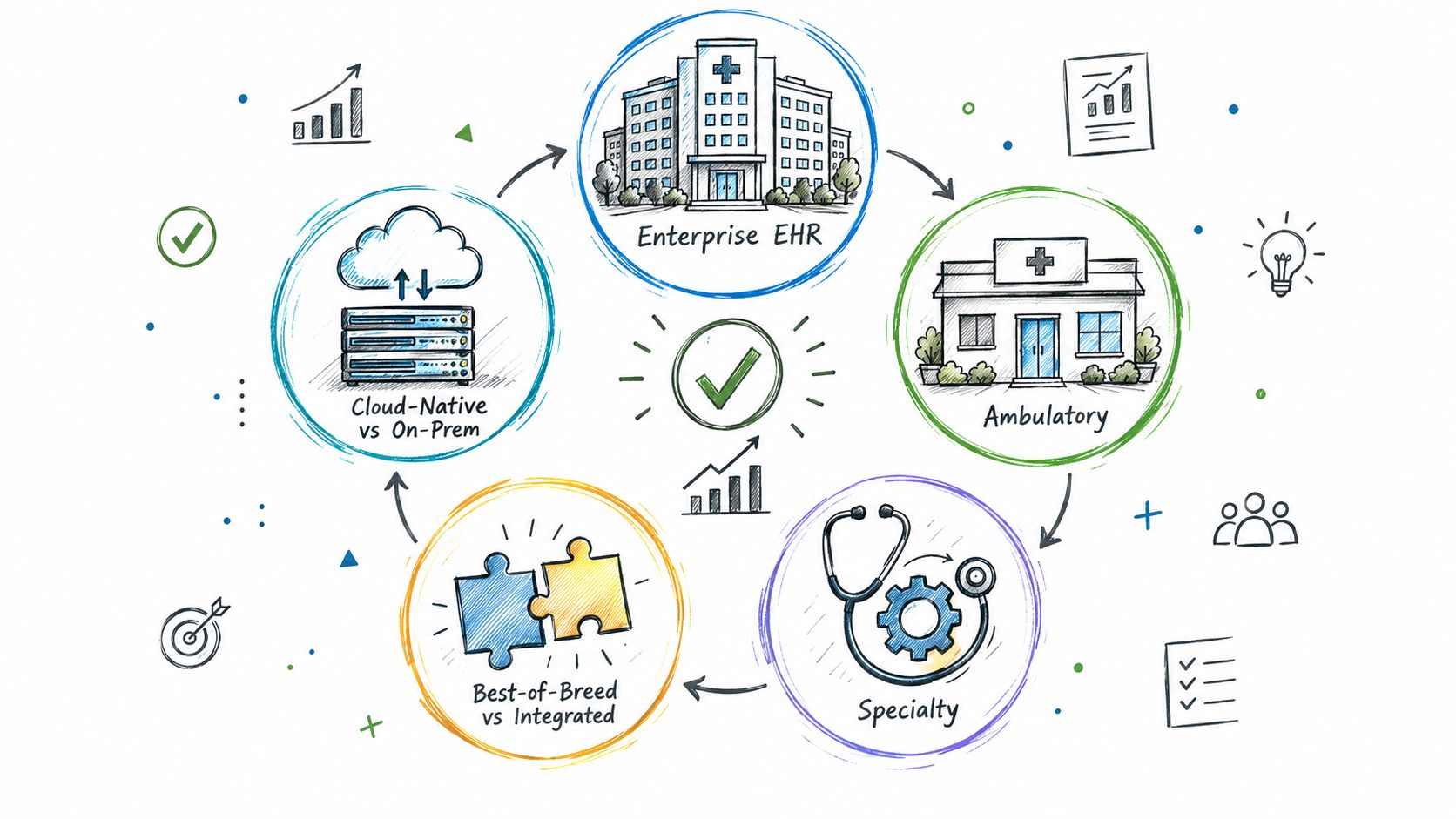
91% of office-based physicians reported using a certified EHR in 2024, up from about 40% using any EHR in 2008, according to the ONC data brief on office-based physician EHR adoption. That adoption level makes the next question the most important one for engineering teams, because types of EHR systems differ in how they are deployed, which care settings they serve, and how open they are to other software. For a healthtech product team, the customer's EHR type decides which integration options exist, how long implementation will take, and what data you can genuinely access. This guide classifies systems by three practical questions: where the system runs, which care setting it serves, and how open it is, in the US context of ONC certification, HIPAA, and 42 CFR Part 2. Other countries use different classifications and governance rules, so the labels shift even when the engineering problems stay familiar.
The first question is not whether a customer has an EHR, but what kind of system it is. The ONC distinction between a personal health record, an EHR, and an EMR separates patient-controlled records from provider records and from charting that stays inside one practice. That difference changes what you can read, what you can write back, and whether your workflow crosses organizational boundaries. For a non-technical overview, see EHR integration explained plainly.
The more practical classification asks three things about the customer system. Where does it run, which care setting does it serve, and how open is it to other software? A hospital deployment with interface engines, shared identity services, and strict change control creates a different integration path from an outpatient clinic using standard APIs and vendor-managed hosting. Scope, access controls, and implementation time all follow from those choices.
Two customers can buy the same product and still need different work. One may have full API access and clear interface ownership. Another may rely on older message feeds, local middleware, or limited write-back rights. Classify the customer system first, then scope the connection against the actual deployment and governance model, not the vendor name.
On-premise EHRs put infrastructure, patching, backups, uptime, and most security operations on the customer's side. Large hospitals and health systems still use this model when they want tight control over maintenance windows, network topology, data locality, and custom interfaces to internal systems and devices. Oracle Health is a familiar example of a system often deployed in self-hosted or customer-controlled arrangements, with the deployment model driving who owns the operational burden, not just who bought the license. Visit the Oracle Health website for the vendor's current positioning.
Cloud-based EHRs shift most infrastructure work to the vendor. That usually shortens rollout time for outpatient groups and multi-site practices, because the customer is not standing up servers, storage, or backup infrastructure before go-live. Integration still takes work, but the operational boundary is clearer. The vendor manages the platform, and the customer manages configuration, workflow, and access governance in the application layer.
Vendor-hosted and hybrid setups sit between those two poles. The vendor may run the core application, but the customer still controls parts of the environment, local interfaces, or connected services. That split can help organizations with existing data center investments or mixed populations of sites, but it also makes responsibility mapping harder. For integration teams, the first question is who owns uptime, patch timing, interface monitoring, and data export. The second is whether the vendor's hosted environment exposes the same endpoints and event behavior as the documentation claims.
When a deployment is hybrid, the customer often assumes the vendor owns security. In practice, the customer still owns identity policy, access review, configuration governance, and the downstream systems that receive protected health information.
Deployment model changes implementation time more than many buyers expect. On-premise projects usually need more coordination around firewall rules, interface engines, downtime windows, and validation. Cloud systems can move faster, but they still require authentication, test tenants, and a clean answer on where patient data flows after the API leaves the EHR. Vendor-hosted systems often look simple in procurement and become complex during cutover if the team does not validate export paths, logging, and support boundaries early.
Acute-care EHRs are built around admissions, transfers, discharges, orders, medication administration, bed management, and coordination across high-volume ancillary departments. They usually hold a longitudinal record across the hospital, including notes, medications, orders, results, and encounter context that has to stay aligned across departments. Integration work often depends on HL7 v2 for ADT, orders, and results, with FHIR or proprietary APIs covering newer workflows. The central constraint is coordination, not simple storage.
Ambulatory EHRs center on scheduling, charting, e-prescribing, portal communication, referral management, and billing-adjacent workflows. They usually expose cleaner office-based workflows than inpatient systems, and independent practices, multi-specialty groups, and MSOs often adopt them. For a product team, these systems are usually easier to integrate with when the workflow is narrow and the data set is smaller, but billing, patient engagement, and specialty templates still add complexity. The integration surface may be smaller, yet it can still be inconsistent across locations and specialty workflows.
Specialty EHRs are built around a narrower clinical domain, such as orthopedics, dermatology, cardiology, ophthalmology, or other procedure-heavy practices. They usually hold specialty documentation, procedure histories, imaging references, coding support, and task flows that a general-purpose system often models poorly. The trade-off is fit versus breadth. These systems can reduce customization inside the specialty, but they often need stronger interfaces to hospital records, imaging systems, registries, and referral partners.
Behavioral health EHRs often emphasize psychotherapy notes, treatment plans, medication management, scheduling, and care coordination across a smaller but sensitive dataset. For substance use disorder records, 42 CFR Part 2 adds confidentiality requirements beyond ordinary HIPAA handling, so integration design must account for consent, segmentation, and minimum necessary access at a finer level. Read the regulation text at 42 CFR Part 2 before assuming a normal clinical exchange pattern will work.
Long-term and post-acute care systems track transitions, medication lists, care plans, functional status, therapy documentation, and recurring assessments over extended stays. Their data model often differs from an acute hospital's, because the workflow follows recovery, custodial care, and handoffs rather than episodic treatment. Integrations usually revolve around discharge summaries, medication reconciliation, referral continuity, and medication updates. That changes both the timing of exchanges and the tolerance for stale data.
Home health EHRs focus on visits in the patient's home, remote documentation, visit verification, scheduling, wound care, and ongoing plan-of-care updates. The data is often more distributed because it comes from field staff, mobile devices, and external referral sources. Integration work here usually has to handle offline behavior, delayed sync, mobile authentication, and exchange with a referring facility's main EHR.
A system can be fully digital and still be hard to integrate with if the care setting demands different timestamps, different encounter rules, or different consent logic.
An EMR usually means a digital chart used inside one organization or practice. The ONC distinction helps here, because EMR is the narrower record and EHR is the broader, shareable record. In practical terms, EMR-style systems are often sufficient for internal documentation but weaker for cross-organization exchange.
An EHR is designed to support broader sharing across settings and organizations. That makes it more relevant for referrals, care coordination, and multi-site operations. If you need external interoperability, the label matters because it usually implies a wider integration surface, even if actual openness still depends on the vendor and configuration.
A personal health record, or PHR, is patient-controlled rather than provider-owned. It can be useful for patient engagement, but it is not a substitute for a provider EHR when you need orders, documentation, or regulated clinical workflows. The main engineering question is whether the PHR is a source, a destination, or just a patient-facing view on top of provider data.
Closed systems expose only the interfaces the vendor allows, and sometimes those interfaces are available only to preferred partners. That can work for an organization that wants a single-vendor stack and clear support boundaries. It becomes harder to justify when you need faster app development, patient-facing tools, or cross-vendor exchange without long waits.
Certified EHRs can expose standardized APIs, which changes what an external app can do with less guesswork. ONC's standardized API criterion 170.315(g)(10) matters because it ties FHIR-based access to testable certification expectations. Certification is still a signal, not a guarantee, so teams should verify the published endpoint, capability statement, and enforcement behavior before they scope integration work. The Health IT Certification Program and the CHPL show whether a product holds certification.
Marketplace-style systems let third-party apps, add-ons, or extensions attach through a vendor-controlled review and distribution path. That can speed adoption when the app is already supported in the ecosystem. It also adds governance work, because you still need to confirm scopes, data mapping, support ownership, and rollback behavior across connected apps.
Open-source EHRs give you source-level visibility and more room for customization. OpenEMR's official site describes it as an open-source health information technology project, and OpenMRS presents itself as an open-source medical record system on its official site. Those examples matter when source access, local control, and custom workflows matter more than a packaged rollout. See the official sites for OpenEMR and OpenMRS for their current descriptions.
Integrated suites aim to keep charting, orders, billing, portals, and reporting inside one vendor model. That improves data consistency and reduces mapping drift because the modules share a common record structure. The downside is that customization tends to stay inside the vendor's rails, so replacement or extension work can be slow and expensive.
Modular setups combine a core EHR with specialized apps, interface engines, and point solutions. They fit departments with unique workflows, especially when a team needs best-in-class tools for imaging, behavioral health, population health, or patient engagement. The cost is coordination, because every added module increases interface maintenance, identity matching, and reporting alignment work.
ONC certification shows that a health IT product has been tested against specific criteria for interoperability, security, and API behavior. That matters if you need a product that can participate in programs built around certified technology, and it also narrows the assumptions you can safely make during integration. The safest check is still the Certified Health IT Product List (CHPL), not a sales deck.
The common mistake is assuming that an app labeled “EHR” automatically includes a certified API, standard FHIR support, or production-grade security controls. Certification answers only part of the question. You still need to verify the deployment, the published API endpoint, the access model, and whether the live instance matches the certified configuration.
| Solution | Implementation complexity | Resource requirements | Expected outcomes | Ideal use cases | Key advantages |
|---|---|---|---|---|---|
| Epic | High, lengthy rollouts and deep inpatient configuration | Very high, substantial budget, IT staff, training | Unified hospital-wide workflows, strong analytics and governance | Large acute-care hospitals and integrated delivery networks | Single-platform consistency; large vendor ecosystem |
| athenahealth (athenaOne) | Moderate, SaaS with faster deployment | Moderate, subscription costs, clinic training, RCM resources | Faster time-to-value, improved ambulatory billing and mobile access | Independent practices, MSOs, multi‑specialty outpatient groups | Rapid updates; strong ambulatory RCM and patient tools |
| MEDITECH Expanse (cloud‑deployed) | Moderate, vendor-managed cloud rollout | Lower local infra but ongoing OPEX; vendor support for uptime/patching | Easier multi-site rollout, quicker feature delivery, managed security | Organizations preferring vendor‑hosted cloud for hospital + ambulatory | Reduced infrastructure burden; managed upgrades/security |
| Oracle Health (formerly Cerner) | High, on‑prem control with complex customization | Very high, hardware, databases, HA/DR, 24/7 operations | Highly tailored environment with full control over performance and data locality | Centers requiring maximum control and bespoke integrations | Maximum control and customization for complex environments |
| ModMed EMA | Low–moderate, specialty‑focused, quicker adoption | Moderate, SaaS/subscription with specialty content | Better clinician fit and productivity in niche workflows | Specialty outpatient practices (e.g., dermatology, OBGYN) | Specialty‑tuned workflows; less customization needed |
| OpenEMR | Variable, flexible but requires engineering and ops | Low software cost; higher hosting/custom dev support needs | Source‑level control, standards-based APIs, adaptable deployments | Organizations wanting open-source control, research, or custom builds | No license fee; FHIR/SMART support; avoids vendor lock‑in |
| Epic Connection Hub (Best‑of‑Breed) | Moderate–high, integration governance required | Moderate, integration engineering, partner app management | Faster departmental innovation without full EHR replacement | Organizations wanting specialized third‑party apps alongside core EHR | Mix‑and‑match apps via standards; accelerates innovation |
A care coordination startup signs three customers. The first is a large hospital system running an on-premise integrated suite. The second is a multi-site outpatient group on a cloud ambulatory EHR. The third is a behavioral health provider on a specialty system.
For the hospital system, the first integration path is usually an HL7 v2 feed through an interface engine for ADT, orders, and results. The team needs message routing, retry logic, idempotency handling, and patient-merge reconciliation before anything reaches the product layer. That project also needs coordinated testing across inpatient departments, because the same encounter can touch admissions, pharmacy, lab, and discharge workflows.
For the outpatient group, the better path is often a SMART on FHIR app or another FHIR API integration, provided the product is certified and the needed scopes are available. The team can focus on patient lookup, appointments, problems, meds, notes, and messaging rather than hospital-style event streams. Even then, the implementation depends on the exact deployment and whether the vendor exposes the right authorization flow for the tenant.
For the behavioral health provider, the main issue is not just transport. The team must determine which records are subject to 42 CFR Part 2, how consent is represented, and whether the data should be segmented before it reaches downstream systems. A normal clinical integration can fail here if it ignores consent status, substance use disorder record boundaries, or role-based access controls.
The engineering mistake in EHR projects is starting with vendor names or feature lists. A safer approach is to classify each customer system by deployment model, care setting, and openness, then map the integration to the actual data flow and governance model. That tells you who owns infrastructure, who owns patching, which workflows the system was built for, and whether you can expect FHIR, HL7 v2, app-marketplace access, or only proprietary interfaces.
Certification status should be checked before you assume standardized APIs are available. Use the ONC Health IT Certification Program and the CHPL to verify the product and version, then confirm whether the deployment exposes the certified capabilities you need. For behavioral health, identify any records covered by 42 CFR Part 2 before you define exchange rules, because consent and segmentation can change the entire design.
HIPAA technical safeguards still apply to the deployment you build around the EHR. Access control, audit controls, authentication, integrity, and transmission security under 45 CFR 164.312 need evidence in the implementation, not just language in the contract. In practice, that means you need logs, policy settings, enforced scopes, and test results that show the controls work.
For product teams, the right question is never only “which EHR does the customer use?” It is “where does it run, what does it cover, and what does it let us access safely?” If you want to scope an EHR integration, we can help you map the customer's system to the right architecture and constraints at Ekipa's healthcare engineering page.
What are the main types of EHR systems?
The most useful breakdown is by deployment model, care setting, and openness. That usually means on-premise, cloud-based, and vendor-hosted systems, plus acute care, ambulatory, specialty, behavioral health, long-term care, and home health variants. Scope terms like EMR, EHR, and PHR help too, but they do not replace the operational classification.
How do I know if an EHR is ONC certified?
Check the product on the Certified Health IT Product List. The ONC certification program explains the criteria, but CHPL is the practical place to verify the product and version. Don't assume a vendor's website means the deployed instance is certified.
What does certified FHIR API support mean?
It means the product has met specific ONC test criteria for standardized API behavior, but you still need to verify the deployed endpoint and authorization setup. The standardized API criterion 170.315(g)(10) is the starting point, not the full integration plan. Testing should confirm scopes, capability statements, and response behavior in the live environment.
Why does 42 CFR Part 2 matter for behavioral health EHR integrations?
It adds confidentiality requirements for substance use disorder records that can affect consent and data sharing. If your product sends data downstream, you need to know whether those records must be segmented or withheld. The regulation text is the right reference point before you design any exchange flow.
Should we integrate with HL7 v2 or FHIR first?
Use the interface the customer supports and the workflow requires. HL7 v2 is still common for ADT, orders, and results in hospital environments, while FHIR is often better for patient-facing apps and modern API access. Many real implementations use both.
What is the fastest EHR type to integrate with?
Cloud ambulatory systems are often faster to start with because they avoid local infrastructure and usually have clearer API access. That said, speed still depends on certification, tenant setup, data permissions, and the vendor's support model. A small specialty system can still be slower if its workflows are heavily customized.
If you're planning an EHR integration or comparing customer systems, Ekipa can help you define the data flows, security controls, and implementation path before engineering starts. Visit Ekipa AI to see how we support healthcare software teams working with EHRs, HL7, FHIR, and regulated clinical workflows.
Compare Fhir vs. hl7 standards for healthtech integration. See how HL7 v2 and FHIR differ in use, mechanics, regulation, and real-world architecture.

A practical EMR software development guide covering build vs extend decisions, ONC certification, FHIR integrations, and clinical workflow design.

Learn what an EMR is, how it differs from EHR and PHR, what it contains, and why it matters for healthtech teams building integrations and AI features.
Connect with our team to explore how AI expertise can transform your business.